Chapter 7: The Flowery Monk Uproots a Willow; Panther Head Enters White Tiger Hall
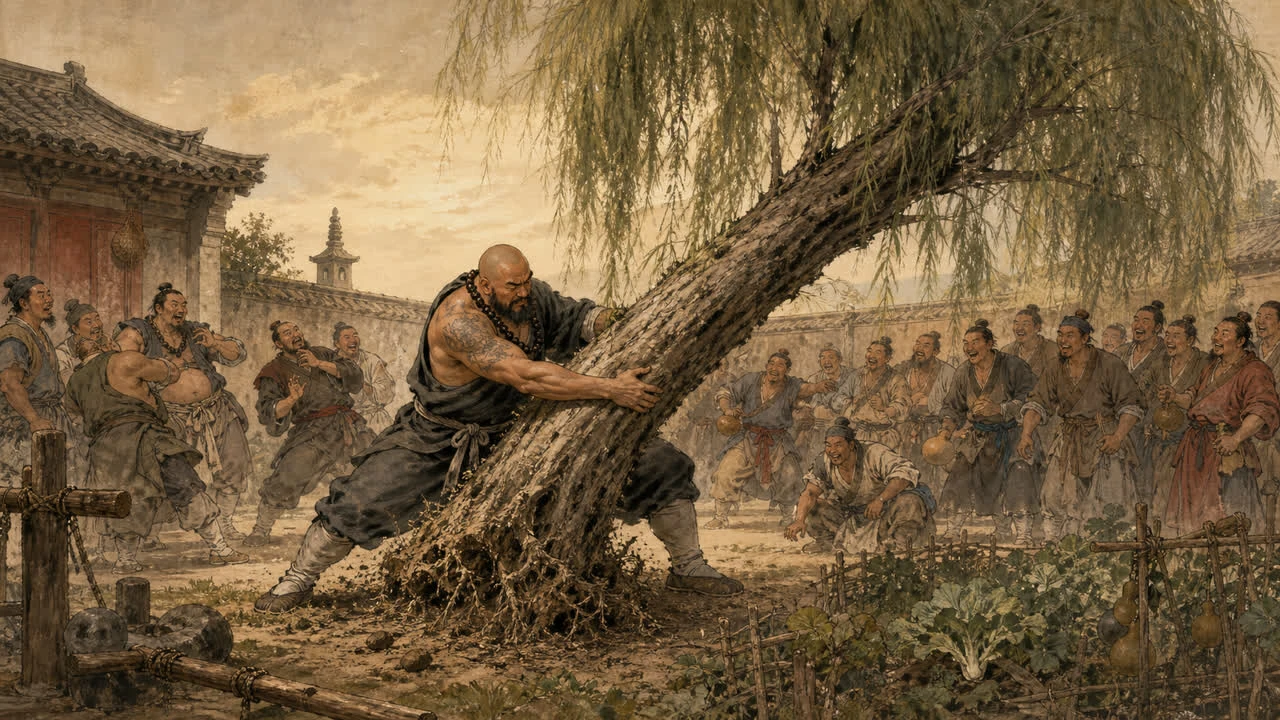
Outside the Sour Date Gate, among the two or three dozen local ruffians and idlers, two men held sway. One was called Zhang the Rat Who Crosses the Street, and the other Li the Grass Snake. These two came forward to greet Lu Zhishen just as he reached the manure pit. The whole gang stood around the edge, not moving, and called out together: “We’ve come especially to congratulate the monk.”
Zhishen said: “Since you’re all neighbors from the streets around, come inside the lodge and sit.”
Zhang and Li prostrated themselves on the ground and refused to rise. They were hoping the monk would come over to help them up—then they’d grab him. Zhishen saw through this at once and thought: “This lot is shady, and they won’t come close. Are they trying to trip me? The bastards are plucking the tiger’s whiskers! I’ll walk right up and show them what my hands and feet can do.”
He strode boldly toward them. Zhang and Li said: “We little brothers have come especially to pay our respects to the master.” As they spoke, they rushed forward—one lunging for his left leg, the other for his right.
Zhishen didn’t wait for them to touch him. His right foot shot up, and with a thud Li flew into the manure pit. Zhang tried to run, but Zhishen’s left foot followed in an instant, and both ruffians were floundering in the filth. The twenty or thirty behind stared dumbstruck, ready to flee.
Zhishen roared: “Whoever runs, goes in! One runs—one goes down. Two run—two go down!”
None of them dared move. Then Zhang and Li raised their heads from the pit. It was bottomless deep, that cesspool. The two were covered in stinking filth, maggots crawling through their hair, as they called out: “Master, forgive us!”
Zhishen bellowed: “You lot of idlers, haul those birds up at once and I’ll spare the rest of you.”
They hurried to help, pulling the two over to the gourd trellis, where the stench was so foul no one could get near. Zhishen laughed heartily: “You stupid creatures! Go wash yourselves in the garden pond, then come talk with me.”
The two washed themselves as best they could, and the others lent them clothes to wear. Zhishen called out: “Come all of you into the lodge and sit down for a talk.”
He took the seat in the middle and pointed at them: “You pack of birds, don’t try to fool me. What sort of men are you, coming here to make sport of me?”
Zhang, Li, and all their companions knelt at once. “We were born and raised here, and we make our living from gambling. This vegetable garden is our rice bowl. The Daxiangguo Temple has tried several times, spending money to get rid of us, but they never could. Master, where do you come from? We’ve never seen such a monk in the temple! From today on, we willingly serve you.”
Zhishen said: “I was a military instructor under General Zhong in Yan’an, in the west. I killed too many men, so I chose to become a monk and came here from Mount Wutai. My lay surname is Lu, my monastic name Zhishen. Don’t talk about your two or three dozen—even against an army of thousands I could cut my way in and out.”
The ruffians murmured their assent, bowed, and left. Zhishen went into the lodge, tidied his quarters, and slept.
The next day the gang pooled their money, bought ten jugs of wine, and led a pig over to feast Zhishen. They set everything up in the lodge, seated Lu Zhishen at the head, and arranged themselves on either side—all twenty or thirty of them drinking. Zhishen said: “Why should you good people spend your money on me?”
They replied: “We’re lucky to have a master here today to look after us.”
Zhishen was delighted. They drank until half drunk—some sang, some talked, some clapped, some laughed. In the midst of their racket, they heard crows cawing outside the gate. Several men clicked their teeth and chanted: “Red mouth up to heaven, white tongue into the earth.”
Zhishen asked: “What’s all this nonsense?”
“Crows calling means there’ll be quarrels,” they said.
“Where’d you hear that?” Zhishen demanded.
The temple attendant laughed. “On the green willow by the corner wall a crow has built a new nest, and it caws from morning till night.”
Some of the gang said: “Let’s get a ladder and tear down the nest.” Others chimed in: “We’ll go now.”
Zhishen, riding the wine’s excitement, went out with them to look. Sure enough, there was a crow’s nest in the green willow.
“Get a ladder and pull it down,” they said. “That’ll give us some peace and quiet.”
Li the Grass Snake said: “I’ll climb up for you—no ladder needed.”
Zhishen studied the tree a moment, walked up to it, took off his monk’s robe, gripped the trunk low with his right hand while leaning his body down, caught hold higher with his left, gave a single heave of his waist—and tore the green willow out by the roots.
The ruffians all fell to their knees. “Master is no ordinary man! You’re a true arhat. With strength of ten thousand catties, how could you not pull it up?”
Zhishen said: “What’s so hard about that? Tomorrow come watch me drill with weapons.”
That evening the gang dispersed. From then on, these two or three dozen idlers were completely cowed. Every day they brought wine and meat to invite Zhishen, watching him practice his martial arts.
After several days Zhishen thought: “I’ve eaten and drunk their food plenty. Today I should return the favor.”
He sent an attendant into town to buy fruits and a few loads of wine, then slaughtered a pig and a sheep. It was late spring, and the weather had turned hot.
“It’s warm,” Zhishen said, and had the attendant spread reed mats under the green locust tree. He invited all the ruffians to sit in a circle. They poured wine by the big bowl and cut meat in thick slabs. When they had eaten their fill, he brought out fruits, and the wine flowed freely.
The gang said: “These past days we’ve watched you train your strength, Master, but we haven’t seen you handle a weapon. Won’t you show us?”
“Well said,” Zhishen replied.
He went into his room and brought out his iron staff—five feet long, weighing sixty-two catties. When the men saw it, they were astonished: “With arms no bigger than a water buffalo’s, how can you swing that thing?”
Zhishen took it up and set it whirling. It moved around his body without the slightest hitch. The crowd roared its approval.
Just as he was in full flow, an official on the other side of the wall shouted: “Truly well done!”
Zhishen stopped and looked. There at a gap in the wall stood an officer—a green gauze headcloth with a twisted knot at the crown, two white jade rings linked behind his ears, a battle robe of green silk figured with clustered flowers, a silver belt patterned with turtle-shell scales and twin hanging tails, black boots with gourd-shaped toes, and in his hand a folding Sichuan fan. He had a leopard’s head, round eyes, a swallow’s jaw, tiger whiskers, stood about eight feet tall, and was thirty-four or thirty-five years old.
He said: “This monk is truly extraordinary! What fine weapon work!”
The ruffians murmured: “If this instructor praises you, it must be good.”
Zhishen asked: “Who is that officer?”
“That’s Instructor Lin, weapons master of the Imperial Guard—Lin Chong by name,” they said.
“Then let me invite him over to meet,” Zhishen said.
The instructor leaped over the wall, and the two met under the locust tree and sat down together. “Where are you from, brother monk? What is your monastic name?” Lin asked.
“I’m Lu Da of the west,” Zhishen replied. “I became a monk because I killed too many men. When I was young I came to the Eastern Capital and knew your father, Instructor Lin.”
Lin Chong was pleased and at once swore brotherhood with Zhishen as the elder.
“Why are you here today, instructor?” Zhishen asked.
“My wife and I just came to the temple next door to burn incense,” Lin said. “When I heard your staff work, I couldn’t take my eyes off it. I sent our maid Jin’er with my wife to make the offering while I waited here—and so I met you, brother.”
Zhishen said: “I just arrived and knew no one until these brothers kept me company every day. Now that you’ve honored me with your friendship and sworn brotherhood, it’s excellent.” He called for more wine.
They had drunk only three cups when the maid Jin’er came running to the wall gap, red-faced and frantic: “Sir, don’t sit there! Your wife is in an argument at the temple!”
“Where?” Lin Chong demanded.
“Just below the Wuyue Tower,” she gasped. “A shameless scoundrel blocked her way and won’t let her go.”
Lin rose hastily. “I’ll come see you again, brother—forgive me.” He vaulted over the wall and ran with Jin’er to the temple.
At the Wuyue Tower he found several men standing at the railing, holding slingshots, blowpipes, and sticky poles. On the stairway a young man stood with his back turned, barring Lin Chong’s wife.
“Come upstairs,” he was saying. “I want to talk with you.”
Her face flushed red: “In this peaceful world, what right do you have to molest an honest woman?”
Lin Chong rushed up and seized the young man by the shoulder, spinning him around. “What crime is it to harass another man’s wife?” He raised his fist—then recognized the young man as Gao Yanei, the adopted son of Marshal Gao Qiu.
Gao Qiu, newly risen in the world, had no son of his own and needed help in his affairs, so he had taken his nephew—the son of his elder cousin Gao Sanlang—as an adopted heir. Though they were cousins by blood, the young man now called him father, and Marshal Gao doted on him. In the capital this fellow threw his weight around, specializing in corrupting other men’s wives and daughters. Everyone feared his power; no one dared cross him. They called him “Flower Prince of Evil.”
When Lin Chong recognized him, his hand went slack. The young man said: “Lin Chong, what business is it of yours? Why are you meddling?” He hadn’t known the woman was Lin’s wife; if he had, this wouldn’t have happened. Seeing that Lin wouldn’t strike, he grew bold.
The idle onlookers crowded around to mediate: “Instructor, forgive him—the young master didn’t recognize her. It was all a mistake.”
Lin’s anger hadn’t cooled. He glared at the young man until the crowd hustled Gao Yanei out to his horse and away.
Lin Chong led his wife and maid back through the gallery. There came Zhishen, iron staff in hand, with the two or three dozen ruffians behind him, charging into the temple.
“Brother, where are you going?” Lin asked.
“I’ve come to help you fight!” Zhishen said.
Lin explained: “It was Marshal Gao’s adopted son. He didn’t know my wife and behaved rudely for a moment. I would have beaten him soundly, but it wouldn’t look well for the marshal. As the old saying goes: ‘Fear not the office—fear the officer.’ I draw my pay from him, so I let it pass this once.”
“You may fear your marshal,” Zhishen said, “but what do I care about him? If I run into that bird, he’ll taste three hundred strokes of my staff!”
Seeing that Zhishen was drunk, Lin said: “You’re right, brother. The crowd persuaded me, so I let him off for now.”
“If anything happens,” Zhishen said, “call me and I’ll go with you.”
The ruffians saw he was drunk and steadied him. “Master, let’s go. We’ll meet again tomorrow.”
Zhishen picked up his staff: “Sister-in-law, forgive me—don’t laugh at me. Brother, we’ll meet again tomorrow.” And he went off with the gang.
Lin Chong led his wife and maid home, brooding all the way.
Gao Yanei, having seen Lin Chong’s wife and been driven away from her, was utterly smitten. He returned to the mansion in low spirits. After two or three days of watching him mope, his hangers-on drifted away—all but one. Fu An, nicknamed “Dry Crow’s Head,” understood what ailed him and came alone to wait on him.
Finding the young master sitting idle in his study, Fu An approached: “Your honor looks thin these days and finds no joy in anything. Something must be troubling you.”
“How would you know?” Gao Yanei asked.
“Let me guess, and I’ll have it in one.”
“Go on then—guess what weighs on my mind.”
“You’re thinking of that woman whose name is made of two trees—Lin.” Fu An grinned. “Am I right?”
The young man laughed. “Right enough. But there’s no way to get her.”
“What’s so hard about it?” Fu An said. “You fear Lin Chong because he’s a tough fellow, but that shouldn’t stop you. He serves under the marshal and draws his pay—would he dare offend him? At worst we have him branded and exiled; at best we finish him off. I’ve thought of a plan that will put her in your hands.”
“I’ve seen many pretty women,” Gao Yanei said, “but for some reason only she moves me. My heart is all twisted up over it. If you can get her for me, I’ll reward you richly.”
“There’s my trusted friend Lu Qian, the aide-de-camp,” Fu An said. “He and Lin Chong are thick as thieves. Tomorrow your honor hides in the upper room of Lu Qian’s house with wine laid out, while Lu Qian invites Lin Chong out for a drink—takes him to some place far off like the Fan Tower. Meanwhile I go to his home and tell his wife: ‘Your husband is drinking with Lu Qian and suddenly collapsed on the floor upstairs—come quickly!’ We lure her to the house. Women are soft-hearted, and once she sees a fine fellow like you and hears a little sweet talk, she’ll come around. How does that sound?”
“Excellent!” Gao Yanei cried. “Send for Lu Qian tonight.”
Lu Qian lived in the lane beside Marshal Gao’s mansion. The next day they settled the scheme. Lu Qian agreed readily enough—he cared more for pleasing the young master than for friendship.
Lin Chong, meanwhile, had been glum for days and hadn’t gone out. Around mid-morning he heard someone at the door: “Instructor home?”
It was Lu Qian. “Brother Lu, what brings you?” Lin asked.
“I came to see how you are. Why haven’t you been on the street these last days?”
“Too downhearted to go out.”
“Let me take you for a few cups to lift your spirits,” Lu said.
“Sit awhile and have some tea first.” They drank, then rose to leave. “Sister-in-law,” Lu Qian called through the curtain, “I’m taking my brother home for a few cups.”
Lin’s wife came to the door curtain: “Brother, drink little and come back early.”
The two men strolled about the streets awhile. “Let’s not go to my place,” Lu said. “We’ll have a couple of cups at the Fan Tower instead.” They went up, took a private room, and ordered two bottles of fine wine and rare delicacies.
As they talked, Lin Chong sighed. “Why do you sigh?” Lu asked.
“You wouldn’t understand, brother… A man with real ability who never meets an enlightened master—forced to bow beneath a petty man and swallow this filthy humiliation!”
“Among all the instructors in the guard,” Lu said, “who can match your skill? The marshal treats you well. Who dares humiliate you?”
Lin Chong told him about Gao Yanei’s behavior at the temple.
“The young master surely didn’t know she was your wife,” Lu said. “Don’t let it eat you—just drink.”
After eight or nine cups, Lin needed to relieve himself. He rose: “I’ll go wash my hands.” Downstairs he went out into an alley east of the tavern.
As he came back to the lane mouth, the maid Jin’er ran up: “Sir! I’ve been hunting for you everywhere—here you are!”
“What is it?” Lin demanded.
“After you left with Lu Qian,” she said, “before half an hour passed, a man rushed to our door and told my mistress: ‘I’m Lu Qian’s neighbor. Your husband was drinking with him when he suddenly collapsed—come quickly!’ She asked the Wang woman next door to watch the house and followed him to a small lane by the marshal’s mansion. Upstairs there was wine on the table but no sign of you. As she turned to go down, that young man from the temple appeared: ‘Rest a moment, madam—your husband is coming.’ I ran downstairs in fright and heard her screaming for help. So I searched everywhere for you. I met the medicine seller Zhang, who said he’d seen you enter the Fan Tower with someone, so I came here. Hurry!”
Lin Chong was alarmed. He didn’t wait for Jin’er but raced to Lu Qian’s house in three strides per step. At the top of the stairs the door was shut. Inside his wife cried: “In this peaceful world, how dare you lock an honest man’s wife in here?” And Gao Yanei’s voice: “Dear lady, have pity on me! Even a heart of iron and stone would soften.”
Lin Chong called from the stairway: “Open the door!”
Hearing her husband’s voice, she came to open it. Gao Yanei panicked, pushed open a window, and fled over the wall.
Lin Chong searched the upper floor but found no trace of him. He asked his wife: “Did that beast defile you?”
“No,” she said.
He smashed Lu Qian’s house to pieces. Then he led his wife downstairs. Outside, all the neighbors had shut their doors. Jin’er met them, and the three went home together.
Lin Chong fetched a sharp dagger and ran back to the Fan Tower looking for Lu Qian—but he was gone. He waited at the man’s door all evening; no one came home. At last Lin returned.
His wife urged him: “He didn’t get anything from me. Don’t do anything rash.”
“That beast Lu Qian!” Lin fumed. “We were like brothers, and he tricked me too! If I don’t catch Gao Yanei, at least I’ll take care of that one’s head!”
She begged him not to go out again, and he yielded. Lu Qian hid in the marshal’s mansion and dared not go home. Lin Chong waited three days but never saw him. Those near the mansion noticed Lin’s grim face and didn’t dare ask.
On the fourth day, around mealtime, Lu Zhishen came looking for him. “Why haven’t we seen you these last days?” he asked.
“I’ve been busy,” Lin said. “I should have come to see you. Since you’ve honored my poor home, I ought to offer you wine, but I can’t prepare anything on the spur of the moment. How about we stroll out and buy a few cups in town?”
“Splendid.”
They went out together and drank all day, arranging to meet again tomorrow. From then on Lin Chong spent every day drinking with Zhishen, and gradually his grievance faded.
Gao Yanei, ever since that fright at Lu Qian’s house—fleeing over the wall in terror—had not dared tell his father what happened. He took to bed, sick. Lu Qian and Fu An came to visit him and found him haggard and listless.
“Why do you look so ill?” Lu asked.
“To be honest with you,” Gao Yanei said, “it’s Lin Chong’s wife. Twice I tried and failed to get her, and that scare made it worse. At this rate I haven’t half a year left in me.”
“Set your mind at ease,” they told him. “Leave it to us—we’ll bring you together with that woman if she doesn’t hang herself first.”
Just then the old steward came in to ask after the young master’s health. Lu Qian and Fu An exchanged glances. They waited until the steward had examined the patient, then drew him aside.
“If the young master is to recover,” they said, “the marshal must know the truth. Do away with Lin Chong, and his wife will come to Gao Yanei—then he’ll get well. Otherwise, the young master’s life is surely forfeit.”
“That’s easy enough,” the steward said. “I’ll inform the marshal tonight.”
“We already have a plan,” they said. “Just bring us his word.”
That evening the steward reported to Gao Qiu: “The young master isn’t sick from any ordinary ailment—he’s lovesick over Lin Chong’s wife.”
“When did he see her?” Gao Qiu asked.
“On the twenty-eighth of last month, at the temple. It’s been over a month now.” And he told him Lu Qian’s scheme in full detail.
Gao Qiu mused: “So—because of his wife, we must destroy him? If I spare Lin Chong alone, I may lose my son. What’s to be done?”
“Lu Qian and Fu An have a plan,” the steward said.
“Then summon them for a council.”
The old steward brought both men in. They made their bows. Gao Qiu asked: “My son’s affair—what plan do you two propose? Save my boy, and I’ll see you promoted.”
Lu Qian stepped forward: “Your Excellency, if we do thus and so…” And he laid out the scheme.
Gao Qiu clapped his hands. “Excellent! Carry it out tomorrow.”
Lin Chong, in the meantime, had drunk away his cares with Zhishen and all but forgotten the matter. One day the two were walking together near the Drill Ground Lane when they came upon a big fellow wearing an old battle robe and headcloth, standing in the street holding a fine blade with a straw marker stuck to it.
“No one who knows what this is,” the man muttered aloud. “My precious sword has been buried alive.”
Lin paid no attention, walking on while talking with Zhishen. The man followed behind: “A fine blade—what a pity no connoisseur recognizes it!” Lin kept walking, deep in conversation.
The fellow called out again: “All the Eastern Capital, and not one man who knows weapons!”
At that Lin turned. The man whisked the sword from its scabbard—bright and dazzling to the eyes. Fate had marked this moment for Lin Chong. Without thinking he said: “Let me see it.”
The man handed it over, and Lin took it up, examining it with Zhishen. Its clear gleam dazzled the eye; a cold breath pierced the skin. Seen from afar it was like spring ice in a jade pool, up close like blessed snow on a terrace of jasper. Dense patterns covered the blade—the sword that flew from the prison at Fengcheng, the purple aura that crossed the sky in King Chu’s dream. Even Tai’e and Juque could hardly match it; Moye and Ganjiang were nothing beside it.
Lin was startled. “A fine sword!” he blurted. “How much do you want for it?”
“I ask three thousand strings—but I’ll take two.”
“It’s worth two thousand, but you have no buyer who knows it. If you’ll take a thousand, I’ll buy it.”
“I need money urgently,” the man said. “If you truly want it, I’ll knock off five hundred—make it fifteen hundred.”
“Just one thousand, and I’ll take it.”
The man sighed. “Selling gold as pig iron! Very well—but not a single coin less than that.”
“Come home with me and I’ll pay you.” Lin turned to Zhishen: “Brother, wait for me at the teahouse a moment.”
Zhishen said: “I’ll go on back. We’ll meet tomorrow.”
Lin Chong took the seller home, paid him, then asked: “Where did you get this blade?”
“It was handed down from my grandfather,” the man said. “My family fell on hard times, so I have to sell it.”
“Who was your grandfather?”
“If I told you, it would shame his memory!” The man pocketed his silver and left.
Lin Chong turned the sword over and over, admiring it: “What a fine blade! Marshal Gao’s mansion has one he never lets anyone see. I’ve asked to borrow it several times, but he won’t even show it. Today I’ve bought my own—I’ll compare them with him by and by.”
That night he couldn’t put it down, and when at last he hung it on the wall, he was up before dawn to look at it again.
The next morning around ten, two messengers appeared at his door: “Instructor Lin! The marshal’s order: we hear you’ve bought a fine sword. Bring it for comparison—he awaits you at the mansion.”
Lin thought: “Who’s been running their mouth?” But he put on his clothes, took the blade, and followed.
“I don’t recognize you two from the mansion,” he said.
“We’re new attendants,” they replied.
They reached the gate and entered the front hall. Lin stopped. The messengers said: “The marshal is seated in the rear hall.” They passed through a screen to the back, but the marshal wasn’t there. Lin halted again.
“He’s further inside, waiting for you,” they said. “We’re to bring you in.”
Through two or three more gates they came to an enclosed courtyard ringed with green railings. At the hall entrance the messengers said: “Wait here a moment while we announce you.” They went in.
Lin Chong stood under the eaves holding his sword, but after a full cup of tea they hadn’t returned. Suspicious, he peered through the door curtain and saw above the lintel four characters in blue: WHITE TIGER HALL.
He started. “This is where military strategy is discussed! How dare I walk in unbidden?” He turned to leave—but boots sounded on the floor, and a man entered from outside. It was none other than Marshal Gao Qiu himself.
Lin Chong stepped forward with his sword and made a formal bow.
The marshal roared: “Lin Chong! Without being summoned, how dare you enter White Tiger Hall? Do you know no law? You carry a blade—are you here to assassinate me? I’ve been told that for two or three days you’ve loitered before my mansion with a knife. You must harbor evil intent!”
Lin bowed deeply: “Your Excellency, two of your messengers summoned me and told me to bring the sword for comparison.”
“Where are these messengers?” the marshal thundered.
“They went into the hall.”
“Nonsense! What messengers would dare enter my council chamber? Seize him!”
At his words, twenty men poured from the side rooms. They seized Lin Chong and dragged him off—as a hawk seizes a swallow, as a tiger devours a lamb.
Gao Qiu raged: “You are an instructor of the Imperial Guard! If you know nothing of the law, what is this? You carry a naked blade and force your way into the council hall to murder your superior!”
He ordered Lin Chong taken below. Whether he lived or died was yet unknown. And because of this, great turmoil would spread through the Central Plains, sweeping across the land—until farmers bore brands on their backs and fishermen hoisted banners of rebellion from their boats.
But as for what became of Lin Chong—hear it in the next chapter.