Chapter 23: Chai Jin Welcomes a Guest at Henghai; Wu Song Fights the Tiger on Jingyang Ridge
Song Jiang had slipped away from the drinking table to wash his hands, and as he came back along the corridor he kicked over the handle of an iron fire shovel. The man crouching by the brazier—a tall, fierce-looking fellow—jumped up in a fury, ready to strike him. But at that moment Chai Jin hurried out and called, “Song the Clerk!” and so the name came out.
The big man heard the name “Song Jiang,” dropped to his knees on the ground, and would not get up. “I have eyes but could not see Mount Tai!” he said. “I offended you in my rashness—please forgive me.”
Song Jiang helped him up and asked, “And who might you be?”
Chai Jin pointed. “This man is from Qinghe County. His name is Wu Song, second of his brothers. He’s been here a year now.”
“I’ve heard the name Wu the Second spoken often in the rivers and lakes,” said Song Jiang warmly. “What luck to meet you here today!”
Chai Jin clapped his hands. “When heroes gather by chance like this, it’s rare indeed! Let us all sit together and talk.”
Song Jiang took Wu Song by the hand and led him into the rear hall, where he called for his brother Song Qing to be introduced. Chai Jin invited Wu Song to sit. Song Jiang urged him to take the seat of honor, but Wu Song refused again and again, and at last took the third place.
Chai Jin ordered fresh cups and dishes and pressed wine on all three. In the lamplight Song Jiang studied Wu Song and saw that he was indeed a fine figure of a man: tall and imposing, with eyes like cold stars and brows brushed black as lacquer, a chest broad enough to daunt ten thousand men, and a voice that rang with the ambition of a soaring cloud. Bold-hearted and fearless, he looked like a lion come down from heaven, or some guardian beast seated in their midst—a demon-queller descended to earth.
Song Jiang was much pleased by what he saw, and asked, “Second Brother, how is it you came to be here?”
Wu Song replied, “In Qinghe County, I got drunk one day and quarreled with a petty official. In my anger I struck him once and laid him out cold. I thought I’d killed him, so I fled and took refuge here with Master Chai. That was more than a year ago. Later I learned the fellow didn’t die—he recovered. I was just about to go home and look for my elder brother when I came down with malaria and couldn’t travel. Just now I was shaking with chills, warming myself at that fire in the corridor, when you kicked the shovel handle and startled me into a cold sweat—and I think the fever has broken.”
Song Jiang was delighted to hear it. That night they drank until the third watch, and Song Jiang had Wu Song sleep in the west wing near his own room. The next day Chai Jin slaughtered sheep and pigs and spread a feast for Song Jiang.
Several days later Song Jiang offered silver to buy clothes for Wu Song. When Chai Jin heard of it he would not let him spend the money; he brought out a chest of fine silks and had his own tailor make fitted garments for all three of them.
Now, why did Chai Jin not treat Wu Song well? At first, when Wu Song had come to the manor, he had been received with all courtesy. But afterward, whenever he drank too much, his temper flared, and if any servant failed him in the least he would knock the man down. So there was not a single servant on the estate who spoke well of him. They all complained to Chai Jin about him, and though Chai Jin never drove him away, his welcome cooled considerably. It was Song Jiang who brought Wu Song along with him everywhere, drinking with him day after day, so that his old temper never broke out again.
After some ten days in Song Jiang’s company, Wu Song grew homesick and wanted to return to Qinghe County to see his brother. Both Chai Jin and Song Jiang urged him to stay longer, but he said, “I haven’t heard from my elder brother in a long time—I must go and see him.”
Song Jiang said, “If you truly must go, I won’t hold you back. But if you have leisure, come again and visit us awhile.”
Wu Song thanked them both. Chai Jin brought out gold and silver as a parting gift, which Wu Song accepted with thanks for all his hospitality. He tied up his bundle, slung his staff over his shoulder, and prepared to leave. Chai Jin had wine and food laid out to see him off.
Wu Song wore a new red silk jacket and a white felt hat of the sort sold in Fanyang. With his pack on his back and his staff in hand, he took his leave. But Song Jiang said, “Wait a moment, brother.” He went back to his room, fetched some silver, and hurried out to the gate. “I’ll walk with you a ways,” he said.
Song Jiang and his brother Song Qing accompanied Wu Song. When they had gone five or six li from Chai Jin’s eastern manor, Wu Song turned and said, “Brother, you’ve come far enough—please turn back. Master Chai will be waiting for you.”
“What harm in a few more steps?” said Song Jiang.
They chatted as they walked, and before they knew it another two or three li had passed. Wu Song caught Song Jiang’s sleeve. “Brother, no need to see me farther. As the saying goes: ‘Send a friend a thousand li—still you must part.’”
Song Jiang pointed ahead. “Let me walk with you a little more. There’s a small tavern by the highway—we can drink three cups there and say our farewell.”
They went into the tavern, Song Jiang taking the seat of honor, Wu Song setting down his staff and sitting below him, with Song Qing at the side. They called for wine and ordered dishes, fruit, and vegetables to be set on the table. After several cups, as the red sun sank toward the west, Wu Song said, “The day is growing late. If my brother will not scorn me, let me kneel here and take you as my sworn elder brother.”
Song Jiang was overjoyed. Wu Song bowed four times, and Song Jiang had Song Qing bring out a ten-ounce ingot of silver to give him. Wu Song refused it. “You’re traveling yourself—you’ll need this for expenses.”
“Don’t worry about that,” said Song Jiang. “If you refuse, I won’t acknowledge you as my brother.”
Wu Song could only accept the gift and tuck it into his pouch. Song Jiang paid the wine bill with loose silver. Wu Song took up his staff, and the three went out before the tavern to part. With tears in his eyes, Wu Song bowed and went on his way.
Song Jiang and Song Qing stood at the tavern door until Wu Song was out of sight, then turned back. They had not gone five li when they saw Chai Jin riding toward them with two led horses. Song Jiang was glad to see him, and they rode back to the manor together. From that time on, the two brothers stayed on at Chai Jin’s estate.
Now let us speak of Wu Song. After parting from Song Jiang, he put up at an inn for the night. The next morning he rose early, ate his breakfast, paid his bill, tied up his bundle, took his staff, and set out on the road, thinking to himself: “In the rivers and lakes they call him ‘Timely Rain’—and it’s true! To have made such a brother—my journey was not in vain!”
After several days on the road he came into Yanggu County, though the county town itself was still far off. At noon his stomach began to growl with hunger and thirst, and ahead he saw a tavern with a banner hanging before its door. On it were written five characters: “Three Bowls—No Crossing the Ridge.”
Wu Song went in, sat down, leaned his staff against the wall, and called out, “Host! Bring wine, quick!”
The proprietor set three bowls, a pair of chopsticks, and a plate of hot food before him, then filled one bowl to the brim. Wu Song lifted it and drank it dry. “This wine has real strength!” he said. “What have you got to fill the belly?”
“Only cooked beef,” said the tavern keeper.
“Good. Cut me two or three catties.”
The man brought out two catties of cooked beef on a large platter, set it down, and poured another bowl. Wu Song drank it off. “Fine wine!” he said, and the man filled another. When he had drunk exactly three bowls, no more came.
Wu Song pounded the table. “Host! Why don’t you pour me more?”
“If you want meat, I can bring you more,” said the keeper.
“I want both—more wine and more meat.”
“Meat I’ll cut for you,” said the man, “but no more wine.”
“What nonsense is this?” Wu Song demanded. “Why won’t you sell me wine?”
“Sir, didn’t you see my banner? ‘Three Bowls—No Crossing the Ridge.’”
“And what does that mean?”
“My wine may be country brew, but it has the strength of aged spirits. Any guest who drinks three bowls gets drunk and can’t make it over the ridge ahead. That’s why I call it so. Travelers who stop here drink their three bowls and ask no more.”
Wu Song laughed. “Is that so? I’ve had my three bowls—why aren’t I drunk?”
“This wine is called ‘Bottle-Piercing Fragrance,’ or else ‘Falls at the Door.’ It goes down smooth and sweet, but before long it knocks you flat.”
“Don’t talk rubbish!” said Wu Song. “Think I won’t pay? Pour me three more!”
The tavern keeper saw that Wu Song showed no sign of being affected, so he poured again. Wu Song drank and praised it. “Host, for every bowl I drink I’ll pay you a bowl’s price—just keep pouring.”
“Sir, don’t drink too much,” the man warned. “This wine will lay you out, and there’s no cure for it.”
“None of your bird talk!” said Wu Song. “Even if you slipped knockout drops in it, I have a nose!”
The keeper could not refuse him, so he poured three more bowls. “And another two catties of meat,” said Wu Song.
The man brought the beef and poured three more bowls. Wu Song drank with relish and wanted still more. He pulled out some loose silver from his pocket and called, “Host! Come look at my money—is this enough to cover the wine and meat?”
The keeper looked at it. “More than enough. I’ll give you change.”
“Keep your change,” said Wu Song. “Just pour the wine.”
“Sir, there are still five or six bowls left in the jar! But I doubt you can drink them all.”
“If there are that many, bring every one of them!”
“You’re a big fellow,” said the keeper, “but if you collapse drunk, how could I ever hold you up?”
“If I needed help standing, I wouldn’t be much of a man,” Wu Song retorted.
The keeper still refused to pour. Wu Song grew hot. “I’m not drinking your wine for free! Don’t make me lose my temper—I’ll smash this place to splinters and turn your stinking shop upside down!”
“This fellow’s drunk,” the keeper muttered. “Best not provoke him.” And he poured out six more bowls, which Wu Song drank one after another. In all he had drunk fifteen bowls. He seized his staff, stood up, and said, “And I’m not even drunk!” Then he walked to the door, laughed, and called back: “What about your ‘Three Bowls—No Crossing the Ridge’?” With that he set off down the road, staff in hand.
The tavern keeper ran out after him. “Sir! Where are you going?”
Wu Song stopped and turned. “What do you want? I don’t owe you anything—why call me back?”
“I mean you well!” cried the man. “Come back inside and read the official notice!”
“What notice?”
“There’s a tiger on Jingyang Ridge ahead—a big one with a white forehead and staring eyes! It comes out at dusk and kills people—it has already taken thirty or more lives. The magistrate has set deadlines and beatings for the hunters to catch it. There are notices posted where the road meets the ridge: travelers may cross only in bands, between nine in the morning and three in the afternoon. At any other hour, no one is allowed up there, especially single men. It’s just past three now—but I saw you walk off without asking anyone. You’d be throwing your life away! Better stay here tonight and wait for thirty or so travelers to gather, then cross together tomorrow.”
Wu Song laughed. “I’m from Qinghe County. I’ve been over Jingyang Ridge a score of times and never heard of any tiger! Don’t try to scare me with such bird talk. And even if there were a tiger—I wouldn’t fear it!”
“I only want to save you!” said the keeper. “If you don’t believe me, come in and read the official notice.”
“You stinking crow!” Wu Song snapped. “Even if there really is a tiger, I don’t care! You want me to stay the night—are you plotting to rob me or murder me at midnight, scaring me with your tall tale?”
The keeper shook his head. “There you have it! A good heart repaid as malice! If you won’t trust me, go on your way!”
He turned and went back into his shop. Wu Song gripped his staff and strode off toward Jingyang Ridge.
After four or five li he came to the foot of the ridge, where a large tree had been stripped of its bark to show white wood beneath, with two lines written on it. Wu Song could read a little, so he looked up and saw:
“Because a tiger on Jingyang Ridge has recently killed men, all traveling merchants are advised to cross in groups between the hours of nine and three. Do not risk your lives.”
Wu Song laughed again. “That tavern keeper’s trick—trying to scare travelers into staying at his place! What do I care about any bird of a tiger?” He dragged his staff along and started up the ridge.
It was now late afternoon, and the red sun hung low over the hills. Wu Song climbed on with the wine buzzing in his head. Before he had gone half a li he came upon a crumbling shrine to the mountain god, and pasted on its door was an official notice bearing a seal. He stopped to read it:
“Proclamation of Yanggu County: A large tiger has recently appeared on Jingyang Ridge and taken human lives. Village headmen and hunters have been ordered under penalty of beating to capture it, but without success. Traveling merchants are hereby instructed to cross the ridge in groups between the hours of nine and three. At all other times, and for those traveling alone, crossing is forbidden, lest lives be lost. Let all take note.”
Wu Song read the sealed notice and knew at last that the tiger was real. He thought of turning back to the tavern, but then he reflected: “If I go back now, he’ll laugh at me. That would not be worthy of a true man.” He stood thinking for a while, then said aloud: “What is there to fear? Let me just go up and see!”
He walked on, and as the wine surged into his head he pushed his felt hat onto his back, tucked his staff under his arm, and climbed step by step. The sun was sinking fast—it was late autumn, when days are short and nights long. “What tiger?” Wu Song muttered to himself. “People just scare themselves and won’t go up.”
After a while the wine took full hold of him. He grew hot, opened his jacket at the chest with one hand, and went staggering along through a tangle of trees until he came upon a great flat blue boulder. He leaned his staff against it, stretched out on the stone, and was about to doze off when a wild gust of wind rose up.
Now, as the old saying goes: clouds rise with dragons, wind rises with tigers. And after that gust passed, there came a sudden roar from behind the thicket, and a tiger leaped into view—a huge beast with a white forehead and staring eyes.
“Aiya!” Wu Song cried, rolling off the boulder and snatching up his staff. He dodged to one side of the stone.
The tiger was hungry and thirsty. It pressed its forepaws into the ground once or twice, then sprang at him from midair. The shock drove all the wine out of Wu Song in cold sweat. But quick as thought he dodged sideways, slipping behind the beast’s back. A tiger cannot easily see what is behind it, so it planted its front paws and heaved up its hindquarters to strike backward. Wu Song dodged again. When the tiger found it had missed, it gave a roar like a thunderclap that shook the whole ridge, then lashed out with its iron-hard tail, straight as a pole. Wu Song slipped aside once more.
A tiger attacks in three ways: a spring, a rearward strike, and a tail lash. When all three fail, half its spirit is spent. It roared again and wheeled around to face him. Wu Song swung his staff with both hands and brought it down from above with every ounce of his strength. There was a crack—but he had struck the trunk of an old tree, snapping his staff in two and sending leaves and twigs flying. He was left holding only half a stick.
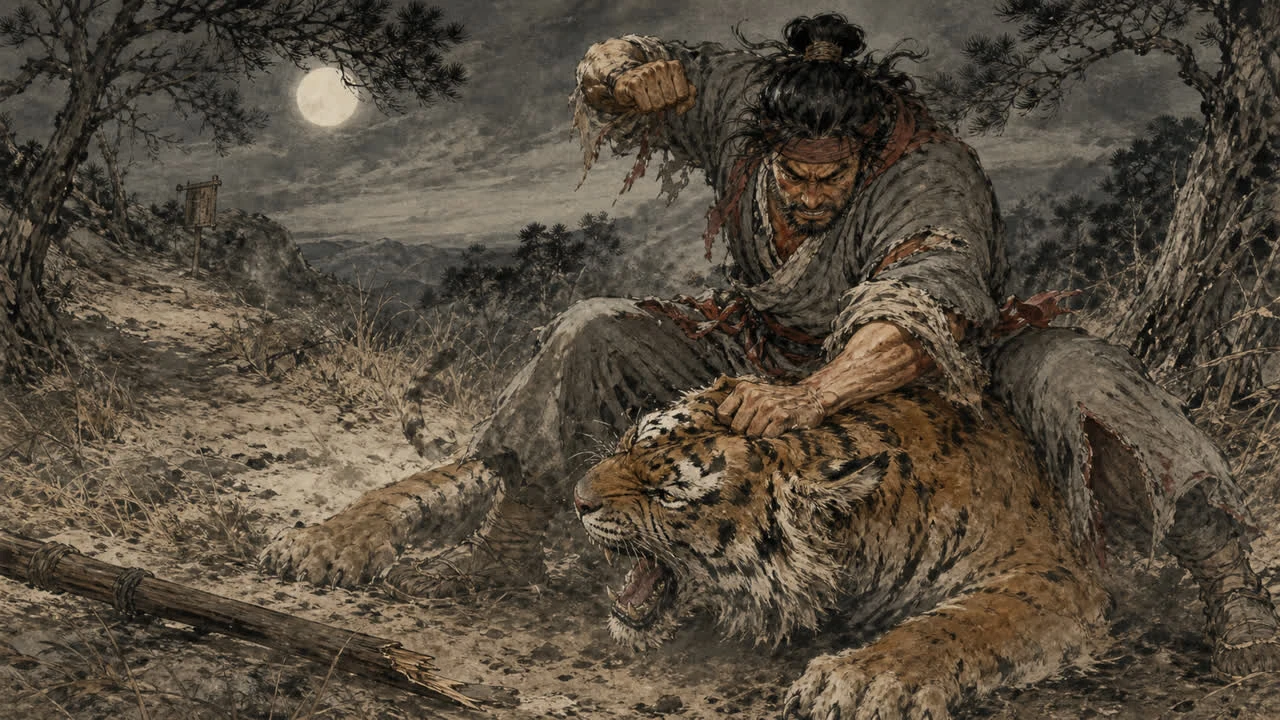
The tiger flew into a rage and sprang again. Wu Song jumped back ten paces, and the beast landed with its forepaws almost at his feet. Wu Song flung away the broken staff, seized the tiger by the loose skin on top of its head, and pressed it down to the ground. The beast struggled wildly, but Wu Song held it fast and would not give an inch. He kicked it again and again in the face and eyes. The tiger roared and clawed up two piles of yellow earth beneath itself until it had dug a pit. Wu Song forced its muzzle down into that muddy hole, and the tiger’s strength ebbed away.
Still gripping the scruff with his left hand, Wu Song drew back his right fist—a fist like an iron hammer—and struck with all his might. After fifty or seventy blows, blood burst from the tiger’s eyes, mouth, nose, and ears. In less time than it takes to eat a meal, Wu Song had beaten the great beast into a limp heap, as if it were a stuffed leather sack.
He let go of the tiger, went to the pine tree where his broken staff lay, picked up the half stick, and beat the animal again for good measure. The tiger gave no sign of life at all.
Wu Song thought: “I’ll drag this dead beast down the ridge.” He took it by the paws, but he could not move it—his strength was spent; his hands and feet had gone weak as water. He sat on the blue boulder to rest awhile and considered: “It’s growing dark. What if another tiger comes? How would I fight it then? Better get myself down the ridge now and come back in the morning.”
He found his felt hat by the stone, picked his way through the thicket, and stumbled step by step down the slope.
He had not gone half a li when two more tigers came out of the withered grass. “Aiya!” Wu Song cried. “This is my end!”
But the two tigers rose up in the darkness—and he saw that they were men, dressed in tiger skins sewn tight to their bodies. Each held a five-pronged fork. When they saw him, they started back.
“What are you made of—a man’s heart, a leopard’s liver, a lion’s leg? Your courage must wrap your whole body! How dare you come over the ridge alone, at nightfall, without so much as a weapon? Are you man or ghost?”
“Who are you two?” Wu Song asked.
“We are hunters from this district.”
“And what are you doing up here?”
The two hunters stared at him in astonishment. “Don’t you know? There’s a huge tiger on Jingyang Ridge that comes out every night to kill! Seven or eight of our own men have been lost, and travelers beyond counting have been eaten by the beast. The magistrate has ordered the village headmen and us hunters to catch it. But the brute is too fierce—who dares get near it? We’ve taken more beatings than we can count trying to capture it. Tonight it’s our turn to hunt, with a dozen or so men from the village. We’ve laid spring-bows and poisoned arrows up and down the slope and were lying in ambush when you came striding down the ridge bold as anything—we nearly jumped out of our skins! Who are you? Did you see the tiger?”
“I am Wu, second brother, from Qinghe County,” said Wu Song. “Just now, by the thicket at the top, I met that tiger and beat it to death with my fists.”
The hunters were dumbfounded. “That can’t be!”
“If you don’t believe me, look—there’s still blood on my clothes.”
“How did you do it?” they asked.
Wu Song told them the whole story of his fight. The two hunters listened, half in fear and half in joy, then called together the ten village men who were hiding nearby with steel forks, crossbows, knives, and spears.
“Why didn’t these fellows come up with you?” Wu Song asked.
“Because that beast is so fierce—they didn’t dare.”
When the hunters told the others what had happened, none of them would believe it. “If you don’t trust me,” said Wu Song, “come and see for yourselves.”
The men carried flint and steel, and soon they had lit five or seven torches. They all followed Wu Song back up the ridge—and there lay the tiger in a heap, dead.
Their joy was unbounded. One man was sent to report to the village headman and the local gentry, while several of the villagers bound the tiger with ropes and carried it down the ridge.
At the foot of the hill a crowd of seventy or eighty had gathered. They bore the dead tiger ahead, brought a sedan chair for Wu Song, and carried him in triumph to the house of a wealthy man of the district, where the headman and his people came out to greet them. The tiger was laid on the thatched terrace, and some twenty or thirty local worthies and hunters crowded around to pay their respects.
“What is your honorable name, hero?” they asked. “Where are you from?”
“I am Wu Song, second brother, from neighboring Qinghe County,” he said. “I was returning home from Cangzhou when I stopped at the tavern on the far side of the ridge last night and drank deep. Then I came up over the ridge—and met this beast.” And he told them again, in detail, how he had fought the tiger.
“Truly a hero!” they all exclaimed.
The hunters brought wild game and poured wine for Wu Song. But he was exhausted from his battle and wanted only to sleep, so the host had a guest room prepared and let him rest.
At dawn the headman sent word to the county seat, while a bier was made ready to carry the tiger into town. When Wu Song rose and washed himself, the local gentry were already waiting in front of the hall with a slaughtered sheep and a load of wine. He dressed, tidied his cap, and came out to meet them.
They raised their cups to him. “That beast took countless lives,” they said, “and brought many beatings upon our hunters. Today your valor has rid us of this great scourge. The people of the countryside are blessed, and travelers may pass in safety—all thanks to you!”
“It was not my strength alone,” Wu Song replied modestly. “I owe it to the good fortune of all you elders.”
They feasted through the morning. Then they brought out the tiger and laid it on the bier. The gentry draped silk and red flowers upon Wu Song, and after he had collected his luggage from the manor house, the whole procession set out. Already an envoy from the county magistrate had arrived to receive him, and four servants carried a sedan chair for Wu Song. With the tiger borne ahead, decked in silks and flowers, they entered Yanggu town.
The people of Yanggu had heard that a hero had killed the tiger on Jingyang Ridge, and they poured out into the streets to see the spectacle—shoulder to shoulder, crowd upon crowd, filling every lane and alley. At the magistrate’s office the county official was already waiting in the hall. Wu Song got down from his chair, and the tiger was carried before them and set on the paved walkway.
The magistrate looked at Wu Song, then at the great striped beast, and thought: “Only such a man could have killed such a tiger!” He summoned Wu Song into the hall.
Wu Song made his bow, and the magistrate asked, “Hero who slew the tiger—tell us how you did it.”
And Wu Song told the whole story again before the assembled officers and clerks, and they all listened in stunned wonder. The magistrate had wine poured for him from the hall’s own supply, then offered him the reward that the local gentry had raised: a thousand strings of cash.
Wu Song declined. “I acted only by your honor’s good fortune,” he said. “It was a lucky accident—not worthy of any reward. I hear these hunters have been punished because of this tiger. Why not distribute this money among them?”
“As you wish, hero,” said the magistrate.
So Wu Song gave the thousand strings to the hunters on the spot.
The magistrate saw that Wu Song was loyal and generous, and he wanted to promote him. “Though you are from Qinghe County originally,” he said, “it is but a step away from Yanggu. How would you like me to appoint you constable of this county?”
Wu Song knelt and thanked him. “If I receive such favor from my lord, I shall be grateful all my life.”
The magistrate ordered the clerk to draw up the papers, and that very day Wu Song was made constable of infantry. The local gentry came to congratulate him, and the feasting went on for three or four days.
Wu Song thought to himself: “I meant to go home to see my elder brother—and here I am, constable of Yanggu instead!” From then on the magistrate favored him, and his fame spread throughout the district.
Two or three days later Wu Song was strolling outside the county office when he heard a voice behind him call: “Constable Wu! You’ve risen in the world—won’t you even look at me?”
Wu Song turned around. “Aiya!” he cried. “What are you doing here?”
And because Wu Song met this man, there would come to Yanggu County blood and corpses laid out across its streets. Steel blades would ring and heads roll; swords would flash and hot blood flow. Who was it that called after Constable Wu? Hear what follows in the next chapter.