Chapter 19: Lin Chong Purges the Marsh Stronghold; Chao Gai Takes Liangshan
Inspector He Tao left the prefect’s hall with his orders and went straight to the secretariat to confer with his men. The officers all said, “That Stone Tablet Village lake district lies hard against Liangshan Marsh—nothing but vast stretches of reeds and water channels. Without a full force of soldiers and boats, who would dare go in there to catch outlaws?” He Tao nodded. “That argument holds.” He returned to the hall and reported to the prefect: “The Stone Tablet Village lakes border directly on Liangshan Marsh, surrounded by deep channels and reed beds. Even in ordinary times they rob people there—and now with that new gang hiding inside, without a large force I wouldn’t dare go in after them.” The prefect said, “In that case, I’ll send another capable patrol inspector with five hundred soldiers to join your pursuit.” He Tao took the order, went back to the secretariat, assembled his men, and selected more than five hundred officers. Each prepared his gear and weapons. The next day the patrol inspector, bearing the Jizhou prefecture warrant, together with He Tao, mustered five hundred troops plus the full company of constables, and they all marched straight for Stone Tablet Village.
Now Chao Gai and Gongsun Sheng, having burned their manor, had brought a dozen or so retainers to Stone Tablet Village. On the way they met the three Ruan brothers, who came out armed to receive them, and they all settled at Ruan Xiaoqi’s home—though Ruan Xiaoer had already moved his family deep into the lakes. The seven sat down to plan their move to Liangshan. Wu Yong said, “At Li Family Ferry there’s Zhu Gui, the ‘Crocodile of the Dry Land,’ who runs a tavern and takes in heroes from all directions. Anyone who wants to join must first go through him. Let’s arrange boats, load up all our goods, and bring gifts to win his introduction.”
While they were still discussing the journey, several fishermen came running with word: “Government troops are racing toward the village!” Chao Gai rose at once. “They’re coming for us—we won’t run!” Ruan Xiaoer said, “No trouble! I’ll handle them myself. Half will drown in the water, and the rest I’ll spear.” Gongsun Sheng added, “Don’t panic! Watch my arts!” Chao Gai said, “Brother Liu Tang, you and Mr. Schoolmaster load the valuables and families onto boats and head straight for Li Family Ferry to wait for us. We’ll see how things look and follow shortly.” Ruan Xiaoer picked two sculling boats, loaded his mother, family, and household goods aboard. Wu Yong and Liu Tang each took charge of one boat, with seven or eight servants at the oars, and set out first for Li Family Ferry. Chao Gai then ordered Ruan Xiaoqi and Ruan Xiaowu to take small boats and meet the enemy in a certain manner—and the two brothers sculled off.
He Tao and the patrol inspector led their troops closer to Stone Tablet Village. Finding boats moored at the river steps, they seized every one. Soldiers who could swim were put aboard to go ahead by water; those on shore kept pace along the bank, so the force advanced both by land and by water together. When they reached Ruan Xiaoer’s house, they raised a shout and burst in—only to find an empty dwelling with nothing but coarse furniture. He Tao said, “Let’s question some nearby fishing households.” The neighbors told him: “His two brothers, Ruan Xiaowu and Ruan Xiaoqi, both live out in the lakes. You can’t reach them except by boat.” He Tao conferred with the inspector: “The lake has many channels, tangled routes, and reed ponds of unknown depth. If we scatter to hunt them, we may fall into their trap. Let’s leave our horses here in the village under guard and all take to boats.” So the patrol inspector, He Tao, and all the constables boarded.
They had seized more than a hundred boats, some poled, some rowed, and all headed for Ruan Xiaowu’s fishing holding. They had gone no more than five or six li across open water when they heard someone singing among the reeds. The troops paused to listen, and the song came:
All my life I fish at Liao’er Bay— I plant no grain, I grow no hemp. Cruel clerks and corrupt officials all slain, With loyal heart I serve the Zhao emperor.
He Tao and his men were startled. In the distance a single small boat came sculling toward them, one man singing as he rowed. Someone who recognized him pointed: “That’s Ruan Xiaowu.” He Tao waved his hand, and the whole force pressed forward, weapons ready to meet him. Ruan Xiaowu burst out laughing and cursed: “You thieving officials who oppress the people—how dare you come courting your old man here? You’re just stroking a tiger’s whiskers!” Behind He Tao some archers nocked arrows, drew their bows full, and let fly together. Seeing the arrows coming, Ruan Xiaowu grabbed his oar, turned a somersault, and dove under the water. The troops rushed up to the boat—and found it empty.
They went on less than two more channels when they heard whistling from the reed beds. The troops spread their boats out and saw two men sculling toward them. At the prow stood one man in a green bamboo hat and green straw rain cape, twirling a long spear, singing as he came:
Old Ruan was born at Stone Tablet Village, Born with a nature that loves to kill. First I’ll take He Tao’s head and the inspector’s too— And send them as tribute to the Zhao king.
He Tao and his men were startled again. They all stared: the one in front twirling his spear and singing, another behind him working the oar. Someone who knew him said, “That’s Ruan Xiaoqi.” He Tao shouted, “All together now—seize that outlaw! Don’t let him get away!” Ruan Xiaoqi laughed at the shout. “Filthy curs!” He touched his spear to the water, spun his boat around, and darted off into a narrow channel. The troops raised a yell and gave chase. Ruan Xiaoqi and his oarsman sculled like flying, whistling as they threaded through the little creeks.
The soldiers chased this way and that until the waterway grew cramped. He Tao said, “Stop! Moor the boats and go ashore.” When they landed, they looked around: nothing but vast reed beds stretching away—not a scrap of dry road to be seen. He Tao felt misgivings and could not make up his mind. He questioned some local villagers, who said, “We live here, but we don’t know all the byways either.” He Tao sent two small boats ahead with three or four constables each to scout the way. Two hours passed—no report came back. He Tao cursed: “Those fellows are useless!” He sent five more constables in another two boats to reconnoiter. Those men sculled off, and more than an hour went by without any return. He Tao fumed: “These are all seasoned officers, sharp and capable—how can they be so witless? Why doesn’t even one boat come back with a report? These soldiers I brought don’t know their heads from their heels!”
The sky was turning dark. He Tao thought to himself: “Here in this endless marsh, what am I to do? I’ll have to go look myself.” He picked a fast little boat, chose several veteran constables, each armed, and with five or six birch oars working, he sat at the prow as they sculled into the reeds.
The sun had already sunk in the west. They rowed about five or six li and saw a man on the bank coming toward them carrying a hoe. He Tao called out: “You there—who are you? What place is this?” The man answered, “I’m a farmer from the village. This is called Dead End Ditch. There’s no road beyond.” He Tao asked, “Have you seen two boats pass this way?” The man said, “Aren’t you the ones coming to catch Ruan Xiaoqi?” “How do you know we’re after Ruan Xiaoqi?” “They’re fighting up ahead in that dark grove.” “How far from here?” “Just ahead—you can see it from there.” He Tao ordered his boat to pull in and sent two constables ashore with forked spears. The farmer raised his hoe, and with one stroke each he knocked both constables head over heels into the water. He Tao started in fright and jumped up to run ashore—but his boat suddenly sheered off, a man burst up from under the water, grabbed He Tao by both legs, and yanked him overboard with a splash. The others in the boat tried to flee, but the hoe-wielding man leaped aboard and cracked them one by one across the head, brains spilling out. The man who had come from beneath the water dragged He Tao up onto the bank and bound him with his own sash. That underwater man was Ruan Xiaoqi; the one on shore with the hoe was Ruan Xiaoer.
The two brothers stood over He Tao and cursed: “We three brothers have always loved killing and burning. What are you worth? How dare you lead troops to capture us?” He Tao pleaded, “Heroes! I only acted under orders from above—I had no choice. How would I dare come after you of my own will? Please take pity on me—I have an eighty-year-old mother at home with no one else to care for her. Spare my life!” The Ruan brothers said, “Let’s truss him up like a dumpling and toss him in the boat’s hold.” They threw the corpses into the water, whistled once, and four or five fishermen emerged from the reeds and climbed aboard. Ruan Xiaoer and Ruan Xiaoqi each took charge of a boat and set out.
Meanwhile the patrol inspector and his soldiers sat in their boats, saying, “He Tao said his men were incompetent, so he went scouting himself—and now he’s been gone a long time without coming back.” It was about the first watch, with the sky full of stars. The troops were resting on their boats when suddenly a strange wind arose:
Sand and stones flew, waves churned to the sky. Black clouds piled up in darkness, urgent rain drove down. Lotus leaves overturned—green canopies tossed across the waves; Reed flowers shaken—white banners tangled around the lake. It snapped the trees on Kunlun’s peak and woke the Old Dragon King of the Eastern Sea.
That freak wind came from behind them, forcing everyone to cover their faces in alarm, crying out in misery as it snapped the mooring lines. Before they could recover, whistles sounded from the rear. Looking into the wind, they saw a blaze of fire shoot out from beside the reed beds. “This is the end!” the troops cried. Their forty or fifty great and small boats were being slammed together by the gale, uncontrollable—and the flames were already sweeping toward them. It was a swarm of little boats lashed together in pairs, piled high with reeds and brushwood, crackling alight, driven straight at them by the wind. The government craft were jammed in a narrow channel with nowhere to dodge. A dozen or more of their largest vessels caught fire as the burning boats drove into their midst. Underwater men were helping push the fires along, and the blaze spread until soldiers aboard the big boats leaped overboard to flee for their lives—but all around was nothing but reed-choked channels with no dry land. The reeds on shore began crackling and burning too. The troops had nowhere to run at either end. The wind whipped and the fire raged, driving them into the mud to stand.
In the midst of the flames appeared a fast little boat: one man sculling astern, and in the prow sat a Taoist with a gleaming sword in his hand, shouting, “Don’t let a single one escape!” The soldiers huddled in panic in the mire. Before the cry died away, two men came out from the east bank of reeds leading four or five fishermen, all brandishing bright knives and spears; on the west bank another two men led four or five fishermen with gleaming fish-hooks. The four heroes and their bands fell to work from both sides, thrusting down the line—and in no time every soldier lay dead in the mud.
On the east bank were Chao Gai and Ruan Xiaowu; on the west, Ruan Xiaoer and Ruan Xiaoqi; the Taoist in the boat was Gongsun Sheng, who had summoned the wind. These five heroes with a dozen or so fishermen killed the whole force among the reeds. Only Inspector He Tao remained, trussed like a dumpling in the boat’s hold. Ruan Xiaoer dragged him ashore and cursed: “You’re a pest that has preyed on the people of Jizhou! I meant to cut you into ten thousand pieces, but I’m sending you back to tell those thieving donkeys at the prefecture: we three Ruan heroes of Stone Tablet Village and Chao Gai, the Heavenly King of East Creek Village, are not to be trifled with! We won’t come begging grain from your city, and they’d better not come seeking death in our village! If they so much as glance at us sideways—never mind a petty prefect, or even Chancellor Cai’s agents coming to seize us—if Cai Jing himself came, I’d stab three dozen holes through him. We’re letting you go. Don’t ever come back! Tell your stinking official he’d better not court death! There’s no main road here, so my brother will see you out.” Then Ruan Xiaoqi loaded He Tao into a fast little boat and carried him to the main channel, where he shouted: “Follow this straight ahead and you’ll find your way. We killed all the others—do you think we’d just let you go free for that prefect donkey of yours to laugh at us? Let’s have your ears as proof!” He drew his dagger and sliced off both of He Tao’s ears, blood streaming down. Then he sheathed the knife, untied the sash, and set him ashore.
He Tao kept his life and found his own way back to Jizhou.
Chao Gai, Gongsun Sheng, and the three Ruan brothers, with a dozen or so fishermen, took five or six boats away from Stone Tablet Village and made straight for Li Family Ferry. There they found Wu Yong’s and Liu Tang’s boats and joined up. Wu Yong asked how the fight against the troops had gone, and Chao Gai told him the whole story. Everyone was delighted. They got their craft in order and all went together to the tavern of Zhu Gui, the Crocodile of the Dry Land, to seek admission. When Zhu Gui saw so many people coming to join the band, he hurried out to greet them. Wu Yong explained their history plainly, and Zhu Gui was overjoyed. He met them one by one, invited them into the hall to sit, and hastily ordered his barman to set out the customary wine for guests. Then he took down a horn-backed bow, fitted a whistling arrow, and shot it toward the reeds across the water. At once a small skiff rowed out from among them. Zhu Gui quickly wrote a letter detailing the heroes’ names, numbers, and backgrounds, gave it to the skiff man to carry into the stronghold for notice, and meanwhile slaughtered a sheep to feast his guests.
They spent the night there. Early the next morning Zhu Gui called for a large boat, invited all the heroes aboard, and together with their own vessels they headed for the mountain stronghold. After some time they reached a water gate where drums and gongs sounded from shore. Chao Gai saw seven or eight lesser bandits rowing out four guard boats; when they recognized Zhu Gui they saluted and went back ahead.
The party landed at Golden Sands Beach, leaving the families’ boats and fishermen to wait there. Several dozen bandits came down the mountain to escort them up to the pass, where Wang Lun led his officers out to welcome them. Chao Gai hurriedly bowed. Wang Lun returned the greeting: “I am Wang Lun. I have long heard the name of Heavenly King Chao—it thunders in my ears. What a joy that you grace our humble lair today.” Chao Gai said, “I’m an unlettered man, crude and rough. Today I come to hide my shortcomings and gladly serve as a common soldier beneath your command—if you will not disdain me.” Wang Lun replied, “Say nothing of the sort. Come up to the stronghold, and we’ll talk further.” The whole party followed the two leaders up the mountain. In the great Assembly Hall, Wang Lun courteously urged Chao Gai and his men to take the higher seats. The seven stood in a row on the right; Wang Lun and his officers lined up on the left. When all the formal greetings were done, they sat as host and guests. Wang Lun summoned the lesser chiefs below the dais to pay their respects, then ordered the stronghold’s drums and music struck up. He sent minor officers down the mountain to attend to the visitors’ retainers, who were lodged in guest quarters below the pass.
Two yellow oxen, ten sheep, and five pigs were slaughtered, and a great feast began with loud piping and drumming. Amid the drinking, Chao Gai told Wang Lun and his officers everything that had happened to him from beginning to end. Wang Lun listened, stunned for a long while, his heart uneasy, unable to speak—he only murmured vaguely through the banquet. When it ended that evening, the officers escorted Chao Gai’s party to the guest quarters below the pass, where servants attended them.
Chao Gai was pleased and said to Wu Yong and the other five: “We committed a crime that reaches heaven—where else could we have sheltered? If not for Chief Wang’s kindness, we would have been lost. We must never forget this debt!” Wu Yong only sneered. Chao Gai asked, “Why do you keep sneering, sir? If something is on your mind, tell me.” Wu Yong said, “Brother, you are too straightforward. Do you think Wang Lun will take us in? Don’t watch his words—watch his face and the way he moves.” “What about his face?” Chao Gai asked. Wu Yong replied: “Didn’t you see at the morning feast how he spoke to you warmly at first? But after you told him how we killed all those soldiers and the patrol inspector and let He Tao go, and what heroes the three Ruan brothers are—his color changed. Though his mouth answered politely, in his heart and bearing he was far from pleased. If he meant to keep us, he’d have settled our seats this morning. Du Qian and Song Wan are crude fellows—what would they know of hosting guests? But Lin Chong is another matter: once an instructor of the imperial guard in the capital, a man of the great city who understands everything. Now, against his will, he sits in the fourth seat. This morning I watched Lin Chong watch Wang Lun answer you—he had an angry air and kept glancing at Wang Lun with troubled eyes. He seems well disposed to us but constrained. Let me drop a few words, and I’ll make this stronghold burn itself from within.” Chao Gai said, “We rely entirely on your clever plan for our refuge.” That night the seven rested.
At dawn the next day word came: “Instructor Lin has come to call.” Wu Yong said to Chao Gai, “Him coming to visit—that plays right into my scheme.” The seven rose hastily and welcomed Lin Chong into the guest hall. Wu Yong stepped forward with thanks: “Last night we were deeply honored by your kindness—we are unworthy of such attention.” Lin Chong said, “I failed in courtesy. Though I wished to show respect, I am not in a position to do so. Please forgive me.” Wu Yong replied, “We may be worthless, but we are not sticks and stones. How could we fail to see your goodwill and concern? We are profoundly grateful.” Chao Gai insisted Lin Chong take the seat of honor, but Lin Chong would not; instead he made Chao Gai sit at the head, taking a lower place himself, with Wu Yong and the other five seated in order below. Chao Gai said, “I have long heard of your fame, Instructor—what a fortune to meet you today.” Lin Chong answered: “When I lived in the Eastern Capital, I kept proper courtesy among friends and never gave offense. Though I am glad to see your face at last, I could not fulfill my heart’s wish before, so I came especially to speak with you.” Chao Gai thanked him warmly.
Wu Yong then asked, “I have long heard that when you were in the capital, Instructor, you were a man of great mettle. How did you come to offend Gao Qiu and be framed by him? Later I heard that at Cangzhou the army’s hay depot was burned—again his doing. And after that, who recommended you to this mountain?” Lin Chong said: “Don’t speak of that villain Gao Qiu’s scheming! My hair stands on end even to mention it—and I have never been able to avenge it! As for my refuge here, it was Lord Chai who recommended me.” Wu Yong asked, “Lord Chai—would that be the one the rivers and lakes call ‘Little Whirlwind’ Chai Jin?” “The very man,” Lin Chong said. Chao Gai put in: “I have often heard that Lord Chai is generous with his wealth and welcomes heroes from all quarters, being a direct descendant of the Later Zhou imperial line. How I would like to meet him!”
Wu Yong turned back to Lin Chong: “A man like Lord Chai, famed across the seas and praised through the realm—if you were not supremely skilled in arms, Instructor, how could he have recommended you? It is no flattery on my part to say that Wang Lun ought by rights to yield you the first seat. That is the common judgment of all the world—and it would do justice to Lord Chai’s letter.” Lin Chong said: “I thank you for your high praise, sir. The truth is I committed a great crime and fled to Lord Chai. It was not that he refused me lodging; rather I feared burdening him, so I came up the mountain of my own will. But now I find no way forward or back! It is not that my seat is low—it is that Wang Lun’s heart is unsteady and his word unreliable. Hard to live with such a man.” Wu Yong said, “Chief Wang treats people with such warmth—how can his mind be so narrow?” Lin Chong replied: “This stronghold has been fortunate that so many heroes have come to help one another—like adding flowers to brocade or rain to drought-stricken seedlings. But this man only fears the talented and envies the able; he worries our power will overshadow him. Last night, when he heard you tell of killing those officers, his face changed and he showed no wish to keep you—that’s why he lodged you here below the pass.” Wu Yong said at once: “If Chief Wang feels that way, let us not wait for him to send us off—we’ll go elsewhere ourselves.” Lin Chong said: “Do not take such an outside view, heroes. I will settle this myself. I only feared you might think of leaving, so I came early to tell you plainly. Today we’ll see how he treats you. If his words are reasonable and unlike yesterday’s, then let the matter drop. But if that fellow says half a word out of line today—leave it to me.” Chao Gai said, “For you to show us such favor—we brothers all feel your kindness deeply.” Wu Yong added: “But we would not want to make you break with your old comrades on our account. If he can accept us, let him; if not, we’ll take our leave at once.” Lin Chong replied: “You are wrong, sir! The ancients said: ‘The wise cherish the wise, and heroes love heroes.’ What use is that vile creature in the end—that filthy beast? Heroes, set your minds at ease.” He rose and took his leave. “We’ll meet again shortly,” he said, and they saw him out as he went back up the mountain.
Not long after, a bandit arrived to invite them: “Today the chiefs of the stronghold ask all you heroes to a feast at the waterside pavilion south of the mountain.” Chao Gai replied, “Tell the chiefs we’ll come shortly.” The messenger left.
Chao Gai asked Wu Yong: “What do you make of this meeting?” Wu Yong laughed. “Set your heart at ease, brother—this gathering may well make you master of the stronghold. Today Instructor Lin will surely be moved to purge Wang Lun. And if he hesitates, I’ll use my three inches of tongue to push him on. Each of you hide a weapon about you and watch for me to stroke my whiskers as the signal—then you all join in.” The seven were secretly pleased.
After mid-morning messengers came repeatedly urging them. Chao Gai and his band dressed carefully, concealing weapons on their persons, then set out for the feast. Song Wan himself rode up to fetch them; seven sedan chairs were brought, and all seven heroes mounted and went straight to the waterside stronghold south of the mountain. The scenery there was extraordinary indeed. They dismounted before the pavilion behind the stronghold, where Wang Lun, Du Qian, Lin Chong, and Zhu Gui came out to receive them and invited them up into the water pavilion, seating them as host and guests. The view all around was beautiful:
Water curtains hung on every side, flowers pressing the crimson rails. Fragrant breezes filled the eye—ten thousand lotus blooms spread over green water; Jade colors met the gaze—a thousand lotus leaves ringed the fragrant pond. Beyond the carved eaves, shady willow shadows; before the latticed windows, the soft sigh of pines. The beauty of rivers and mountains filled the pavilion, where a band of heroes gathered.
Wang Lun with his four officers Du Qian, Song Wan, Lin Chong, and Zhu Gui sat on the left as hosts; Chao Gai with his six—Wu Yong, Gongsun Sheng, Liu Tang, and the three Ruan brothers—sat on the right as guests. Lesser bandits below the dais took turns pouring wine. After several rounds of drink and two courses of food, Chao Gai tried to converse with Wang Lun, but whenever the talk turned to joining the band, Wang Lun deflected it with small talk. Wu Yong glanced at Lin Chong and saw him sitting sideways in his chair, glaring at Wang Lun. They drank on into the afternoon, until Wang Lun turned and ordered a subordinate to bring something.
Three or four men went out and soon returned—one carrying a great tray holding five ingots of silver. Wang Lun rose with his cup and said to Chao Gai: “I am honored that so many heroes have come to this gathering, but I can only regret that our little stronghold is a puddle of water—how could it hold so many true dragons? Let me offer this small gift, and I beg you to accept it. Please go on to some greater lair, and I will send men to submit to your command.” Chao Gai replied: “I had long heard that this mountain welcomes worthy men, so we came especially to join. If there is no room for us, we will withdraw of our own accord. As for the silver you kindly offer—I dare not accept it. Not that I boast of wealth, but I have some traveling money with me. Please take back your generous gift; we’ll say goodbye here.” Wang Lun said: “Why refuse? It is not that this mountain will not receive you heroes—but our grain is scarce and our housing few. I fear that in time we would fail you, and your faces would be shamed. Therefore I dare not keep you.”
Before the words were out of his mouth, Lin Chong’s brows shot up and his eyes bulged wide. From his chair he bellowed: “When I first came up this mountain, you made the same excuse—little grain and few rooms! Now Brother Chao and all these heroes come to the stronghold, and you trot out that speech again. What is the meaning of this?” Wu Yong interposed: “Control your anger, Chief. It is our fault for coming and spoiling your fellowship. Today Chief Wang sends us down with gifts and traveling money—he has not driven us off with heat. Please calm yourself; we’ll go.” Lin Chong said: “This man hides a dagger behind his smile—his words are pure but his deeds foul! I truly cannot let him pass today!” Wang Lun snapped back: “See this beast! He is not even drunk, and yet he speaks to wound me—has he forgotten all rank and order?” Lin Chong flared: “You’re just a failed scholar from the countryside with no learning in your breast—how can you be master of this mountain?” Wu Yong said: “Brother Chao, it seems our coming has spoiled the chief’s good name. Let us ready boats at once and take our leave.”
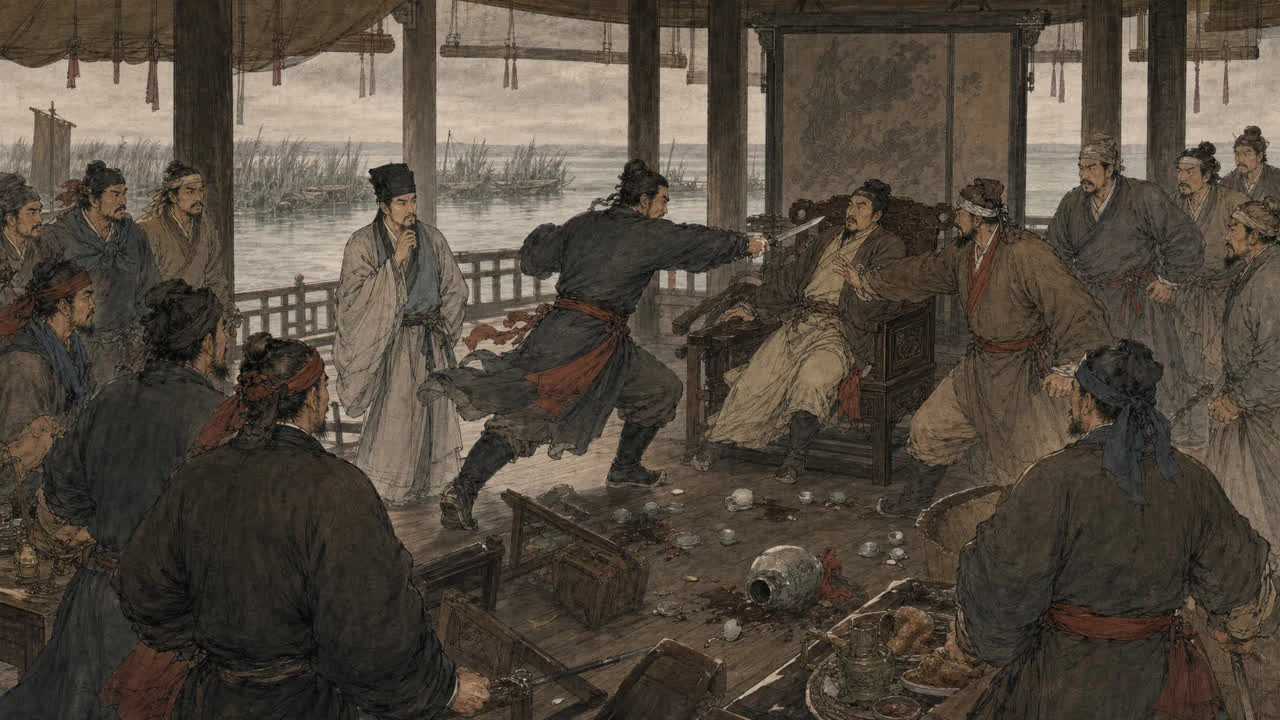
The seven rose as if to descend from the pavilion. Wang Lun called after them: “At least finish the feast!” Lin Chong kicked the table aside with one foot, sprang up, and from under his robe whipped out a gleaming knife, blazing with fury. Wu Yong stroked his whiskers. Chao Gai and Liu Tang stepped onto the pavilion and made as if to hold Wang Lun back, crying: “No fighting among brothers!” Wu Yong grabbed Lin Chong’s arm with one hand, saying, “Chief, do not be rash!” Gongsun Sheng pretended to plead: “Do not ruin our greater cause for us!” Meanwhile Ruan Xiaoer seized Du Qian, Ruan Xiaowu held Song Wan, and Ruan Xiaoqi gripped Zhu Gui—leaving the lesser bandits staring in stupefied horror.
Lin Chong seized Wang Lun and cursed him: “You are a poor village scholar who got here only thanks to Du Qian. Lord Chai supported you with money and friendship; when he recommended me, you made endless objections. Now heroes come to join you, and again you try to send them down the mountain! Is this Liangshan Marsh yours alone? You envious, jealous thief—if I don’t kill you, what use are you? You have neither breadth of mind nor depth of talent, and you cannot be master of this stronghold!” Du Qian, Song Wan, and Zhu Gui would have rushed forward to mediate, but the Ruan brothers held them fast—they dared not move. Wang Lun tried to slip away but was blocked by Chao Gai and Liu Tang. Seeing the situation hopeless, he cried out: “Where are my loyal men?” A few close henchmen might have come to his rescue, but faced with Lin Chong’s ferocity, none dared step forward. Lin Chong seized Wang Lun, cursed him again, and drove his knife straight into his heart—with a single thrust the man collapsed on the pavilion floor. So died Wang Lun, master of the stronghold for many years, slain by Lin Chong’s hand, fulfilling the ancient saying: “Great generosity brings great fortune; deep scheming brings deep ruin.”
When Chao Gai saw Wang Lun killed, he and his men drew their weapons. Lin Chong had already cut off Wang Lun’s head and held it in his hand, and Du Qian, Song Wan, and Zhu Gui fell to their knees: “We will follow you, brother—we’ll hold your reins and stirrups!” Chao Gai hurriedly raised them up. Wu Yong dragged the first seat out of the blood, pressed Lin Chong into it, and proclaimed: “Let anyone who refuses obey take Wang Lun as his example! Today we make Instructor Lin master of this stronghold.” Lin Chong shouted back: “You are wrong, sir! I burned this inhuman wretch today only for the sake of our heroes’ sworn bond. I have no wish at all to seize his seat. If you force me to take first place now, would not every hero under heaven laugh at me? Better death than that! But I have a few words—will you hear them?” Everyone said: “Whatever Chief says, who would dare disobey? Let us hear it.”
And what Lin Chong then said to Wu Yong would bring many men of iron to the Golden Pledge Pavilion and open many assemblies before the Assembly Hall. Truly:
The man who acts for Heaven was on his way; The hero who gives away wealth had come.
But hear the next chapter to learn what words Lin Chong spoke to Wu Yong.