Chapter 1: The Celestial Master Prays Against the Plague; Marshal Hong Unseals the Demons
Edition note: This is a new English literary retelling made directly from the public-domain Chinese 120-chapter Yuan edition on Chinese Wikisource, attributed to Shi Nai'an. It does not reproduce or revise an existing English translation. The event order and chapter divisions follow that text; names use pinyin without tone marks. This opening release contains Chapters 1–12, with newly generated original illustrations.
In the third year of the Jiayou reign period, on the third day of the third month, Emperor Renzong of the Great Song dynasty sat upon his throne in the Purple Morning Hall to receive the morning court. The scene was one of celestial splendor: auspicious clouds wreathed the phoenix pavilions, and blessed vapors shrouded the dragon towers. Palace willows brushed the banners with their misty branches, while dew-laden palace flowers greeted the halberds and swords of the guards. Before the golden steps gathered officials in jade hairpins and crimson shoes; amid celestial music, embroidered robes supported the imperial carriage. Pearl curtains rolled up to reveal the golden palanquin on the gilded dais, and phoenix-feather fans parted before the jeweled chariot at the white jade stairs.
The herald called out: “If any have business, come forward and present it. If none, roll down the curtains and retire.”
From among the assembled ministers stepped Prime Minister Zhao Zhe and Vice Grand Councilor Wen Yanbo. They knelt and reported: “A plague now rages through the capital, killing many soldiers and civilians alike. We beseech Your Majesty to show leniency in punishments, lighten the taxes, and offer prayers to avert this heavenly calamity and save the people.”
The Emperor promptly ordered the Hanlin Academy to draft an edict. One decree pardoned all prisoners throughout the empire and remitted all civilian taxes; another commanded the temples and monasteries of the capital to perform rites to ward off disaster. Yet the plague only worsened.
When Renzong learned of this, he grew uneasy and convened his ministers once more. From the ranks stepped Fan Zhongyan, Vice Grand Councilor, who bowed and said: “The heavenly calamity now rages, and soldiers and people alike suffer beyond endurance. In my humble opinion, to avert this disaster we must summon the Celestial Master of the Han dynasty lineage to come to the capital with all speed, there in the imperial precincts to perform a grand purification of thirty-six hundred portions, reporting our prayers to the Most High God. This may protect the people from the plague.”
The Emperor approved. He ordered the Hanlin scholars to draft an edict, wrote it himself in his own hand, and added a stick of imperial incense. He appointed Marshal Hong Xin of the Palace as imperial envoy, sending him to Dragon-Tiger Mountain in Xinzhou, Jiangxi, to summon the Celestial Master Zhang in all haste to the capital to pray against the plague. On the golden dais the Emperor burned the sacred incense and placed the vermilion edict in Marshal Hong’s hands, bidding him set out at once.
Hong Xin received the imperial command, took leave of the Emperor, strapped the edict to his back, carried the sacred incense, and with several dozen attendants mounted post-horses. The procession left the Eastern Capital and took the road toward Guixi County in Xinzhou. Far-off mountains gleamed emerald, clear waters sparkled below; rare blossoms spread brocade through the forests, tender willows trailed golden threads across the ground. Wind was gentle and sun warm as they passed wild villages and mountain inns; roads ran straight over level sand as they slept at post stations along the way.
After many days’ travel, Marshal Hong arrived at Xinzhou in Jiangxi. All the local officials came out of the city to greet him, then sent word ahead to the abbots of Shangqing Temple on Dragon-Tiger Mountain to prepare for receiving the edict. The next day, the officials accompanied the Marshal to the foot of the mountain, where a host of Daoist priests descended, striking bells and beating drums, bearing incense, flowers, lanterns, candles, banners, and canopies in a parade of celestial music, all to receive the imperial decree.
They escorted him up to Shangqing Temple. The Marshal surveyed the hall—truly a magnificent sight! Twisted green pines and dark cypresses shaded the grounds; above the gate hung an imperial plaque inscribed in gold, and the doors bore talismans carved with jade script. Beside the altar of the Void Sovereign drooped famous willows and rare blossoms; around the alchemical furnace stood ancient junipers. On the left flank, celestial warriors attended the Grand Unity Lord; on the right, jade maidens and golden boys surrounded the Purple Tenuity Emperor. There stood the Dark Warrior of the North with flowing hair and sword, treading on turtle and serpent; there the Old Man of the South Pole in cap and slippers, subduing dragon and tiger. Before them ranked the twenty-eight lunar mansions; behind, the thirty-two celestial emperors. Water murmured along the steps, fine mountains ringed the rear walls. Cranes bore red crowns, turtles grew green fur; gray apes offered fruit from treetops, white deer carried ganoderma in the grass. In the Hall of the Three Purities, priests struck golden bells and paced the void; before the shrine of the Four Sages, adepts tapped jade chimes and honored the Dipper.
From the abbot down to the acolytes and attendants, all welcomed him and led him to the Hall of the Three Purities, where the edict was placed upon the central altar for veneration. Marshal Hong asked the resident abbot: “Where is the Celestial Master now?”
The abbot stepped forward and replied: “Let me inform Your Excellency. This generation’s patriarch bears the title Void-Transcendent Celestial Master. His nature delights in lofty solitude, and he wearies of welcoming and seeing off visitors. He has built himself a thatched hut atop Dragon-Tiger Mountain to cultivate his nature in quiet, so he does not reside here in this temple.”
The Marshal said: “But the Son of Heaven has issued an edict summoning him. How am I to see him?”
The abbot answered: “If I may speak frankly—we dare not open and read the edict; it shall rest in honor in this hall. May I invite Your Excellency to the abbot’s quarters for tea, where we may discuss the matter further?”
So the vermilion edict was left enshrined in the Hall of the Three Purities, and all the officials went with the Marshal to the abbot’s lodging. He sat at the head, attendants served tea, then a full vegetarian feast was laid out—delicacies from land and sea alike. When the meal was done, the Marshal asked again: “Since the Celestial Master is in his hut on the mountaintop, why not send someone to invite him down to meet me and hear the imperial edict?”
The abbot replied: “This patriarch, though he dwells on the mountain, possesses extraordinary powers. He can summon clouds and ride the mist; his whereabouts are never fixed. Even we rarely manage to see him. How could we send anyone to bring him down?”
“Then how am I to see him at all?” said the Marshal. “The capital is stricken with plague. The Son of Heaven has sent me here bearing his own written edict and sacred incense, to invite the Celestial Master to perform a grand purification of thirty-six hundred portions, to avert this heavenly calamity and save the people. What is to be done?”
The abbot said: “If the Emperor wishes to save the people, then Your Excellency must prepare a sincere heart. Fast and bathe in purification, change into plain cloth garments, take no attendants, carry the edict yourself upon your back, burn the imperial incense, and walk up the mountain on foot to worship and entreat the Celestial Master. Only thus may you see him. If your heart is not truly sincere, you will make the journey in vain.”
The Marshal said: “I have eaten vegetarian food all the way from the capital. How can my heart be insincere? Very well—I shall do as you say and go up at dawn tomorrow.”
That night they rested. At the fifth watch the Daoists rose, prepared fragrant hot water, and roused the Marshal to bathe. He changed into fresh plain cloth clothing, put on hempen sandals, ate a vegetarian breakfast, took up the vermilion edict wrapped in yellow silk brocade, strapped it upon his back, and carried in his hand a silver incense burner with the imperial incense smoldering within. The Daoists accompanied him to the rear of the mountain and showed him the path. The abbot again admonished: “Your Excellency wishes to save the people—do not let any thought of retreat arise. Climb on with full sincerity.”
The Marshal took leave of them, chanting the name of the Heavenly Worthy as he strode up the mountain. When he was halfway up, he saw the great summit piercing the clouds—truly a mighty peak! Roots spreading from the earth’s foundations, crown touching heaven’s heart; from afar it seemed to shear through drifting clouds, near at hand it swallowed the bright moon’s soul. High and low ridges, winding cliffside paths, rugged solitary crags, level summits, round-headed knolls, lairs for tigers and leopards, caverns that held wind and cloud, retreats of hermits, haunts of woodcutters—all the forms of mountain country were here. Waterfalls flew slantwise, vines hung upside down; when tigers roared, wind rose from the valley mouths; when apes cried, the moon sank past the hillsides. It was as if black-green dye had painted a thousand blocks of jade, and gauze of emerald veiled ten thousand heaps of mist.
Marshal Hong walked on alone for some time, circling slopes, turning along paths, grasping creepers and vines. After crossing several ridges and three or four li of mountain road, his feet ached and his legs weakened. He did not say a word aloud, but inwardly he grumbled: “I am a noble official of the court. In the capital I sleep on layered cushions and eat from steaming cauldrons, and still I tire easily. When have I ever worn straw sandals or climbed such mountain paths? Who knows where this Celestial Master is—why must I suffer so?”
He had not gone another fifty paces when he stopped, shoulders hunched, gasping for breath. Then from a hollow in the mountain a wind arose, and behind a pine tree came a thunderous roar. A great tiger leaped out—white-browed, white-bellied, its striped golden coat gleaming. Marshal Hong cried out in fright: “Aiya!” and fell over backward.
Through half-closed eyes he saw the beast: golden fur draped in bands of yellow, eighteen silver hooks for claws, eyes like lightning, tail like a whip, mouth like a blood basin, teeth like halberds. It stretched its back and shook its head with a thunderous sound; foxes and hares throughout the mountain hid themselves, deer and roe vanished from the ravines.
The tiger circled Marshal Hong, roaring for a while, then bounded off down the far slope of the mountain. The Marshal lay at the foot of the pine tree, his thirty-six teeth chattering in pairs, his heart pounding like fifteen buckets rising and falling in a well, his whole body numb as if struck by wind-stroke, his legs weak as a beaten rooster’s. He groaned bitterly.
A full quarter-hour passed before he could climb to his feet. He retrieved the incense burner from the ground, relit the imperial incense, and started up the mountain again, determined to find the Celestial Master.
After another fifty paces he sighed heavily and complained: “The Emperor sent me here on his command—and I have to suffer such frights!” No sooner had he spoken than another wind blew up, carrying a poisonous vapor straight toward him. The Marshal stared hard. From among the bamboo and vines at the mountainside came a rustling sound, and out darted a snake as thick as a bucket, white as snow. The Marshal cried out in terror, dropped his hand-warmer, shouted “I am dead this time!” and fell backward beside a rocky ledge.
He cracked one eye open to look. The great serpent raised its head like a rising gale, flashed eyes like lightning; when it moved, it seemed to split ravines and topple ridges; when it breathed, clouds and mist poured forth. Its scales scattered like a thousand flakes of jade, its tail curled up in coils of silver.
The snake slithered straight to the rocky ledge, coiled itself before Marshal Hong, fixed him with golden-glinting eyes, opened its vast mouth, and shot out its tongue, blowing poisonous vapor into his face. His three souls trembled and his seven spirits drifted away. After staring at him for a long while, the serpent slid off down the mountain and vanished.
Only then could the Marshal rise. “Thank heaven!” he gasped. “That nearly killed me!” He examined himself—goosebumps stood out all over his body like dumplings. He cursed the Daoists: “Insolent scoundrels! They mocked me, made me suffer such terrors! If I don’t find their Celestial Master on this mountain, I’ll go down and have words with them!”
He picked up his silver burner, straightened the edict on his back and his clothing and cap, and was about to climb again when he heard from behind a pine tree the faint sound of a flute, growing nearer. The Marshal looked closely and saw a young acolyte riding a yellow ox backward, blowing crosswise upon an iron flute as he came around the mountain hollow.
The boy had two hair buns tied on his head, wore a plain blue robe, a belt woven of straw at his waist, hempen sandals on his feet. Bright eyes and white teeth, utterly free of dust; dark locks and ruddy complexion, without any trace of worldly manner.
As the old poem by Lü Dongbin says:
Grass spread across the wilds for six or seven li,
A few notes from the flute in the evening breeze.
Home again after supper in the yellow dusk,
He sleeps beneath the moon, still in his straw cloak.
The acolyte came riding over the mountain with a smile, playing his iron flute. Marshal Hong called out: “Where do you come from? Do you know who I am?”
The boy paid him no heed and kept on playing. The Marshal called several more times, and at last the boy laughed aloud, pointed his flute at him, and said: “Have you come here to see the Celestial Master?”
Startled, the Marshal asked: “You are only a cowherd—how should you know that?”
The boy smiled. “This morning I was serving the Celestial Master in his hut, and I heard him say: ‘The Emperor has sent a certain Marshal Hong bearing the vermilion edict and imperial incense to summon me to the Eastern Capital for a grand purification of thirty-six hundred portions, to pray against the plague that afflicts the world. I am now mounting my crane and riding off on the clouds.’ By this time he must already be gone—he is not in his hut. You need not climb any higher. The mountain teems with poisonous insects and fierce beasts; they might cost you your life.”
“Don’t lie to me!” said the Marshal.
The boy laughed once more, made no reply, blew on his flute again, and rode off around the slope.
The Marshal thought: “How could this lad know all that? The Celestial Master must have told him. That settles it.” He considered climbing further, but the fright he had suffered still gripped him—he had nearly lost his life. Better to go down.
So he took up his burner and hurried back along the old path to the foot of the mountain. The Daoists received him and led him into the abbot’s quarters. The abbot asked: “Did Your Excellency see the Celestial Master?”
The Marshal said: “I am a noble official of the court! How could you send me scrambling over mountain roads, making me suffer such hardship that I nearly died? First a white-browed tiger leaped out at me halfway up and scared my soul away. Then before I had passed another ridge, a snow-white serpent burst from the bamboo and coiled in my path. If not for my great good fortune, how could I return to the capital alive? It was all your Daoists’ doing—you made sport of me!”
The abbot replied: “How would we dare show disrespect to a minister? This was the patriarch testing Your Excellency’s sincerity. Though this mountain has snakes and tigers, they harm no one.”
“And when I could barely walk,” continued the Marshal, “just as I was about to climb again, an acolyte came around the pine trees riding a yellow ox and playing an iron flute. I asked him where he was from and whether he knew me. He said he knew everything—that the Celestial Master had told him he had mounted his crane at dawn and flown to the Eastern Capital. So I turned back.”
The abbot said: “Your Excellency missed your chance! That cowherd was the Celestial Master himself.”
“If he is the Celestial Master,” said the Marshal, “why does he look so common?”
The abbot replied: “This generation’s master is no ordinary person. Though young in years, his powers are extraordinary. He is one beyond the common run; he manifests himself everywhere and works wonders. The world calls him Patriarch of the Way.”
“I was blind!” said Marshal Hong. “I failed to recognize a true master and let him slip past me!”
The abbot consoled him: “Set your mind at ease, Your Excellency. Since the patriarch has decreed that he is gone, by the time you return to the capital this great purification will already have been completed.”
Only then was the Marshal relieved. The abbot ordered a banquet prepared in his honor, stored the vermilion edict in an imperial document case to remain at Shangqing Temple, and burned the imperial incense in the Hall of the Three Purities. That day they feasted in the abbot’s quarters until evening, and all slept there till dawn.
After breakfast the next day, the abbot, the Daoists, the temple superintendents, and the attendants invited Marshal Hong to tour the mountain. He was delighted. Many attendants followed him on foot as two young acolytes led the way. They walked before and behind the great hall, viewing many sights. The Hall of the Three Purities was magnificent beyond description; in the left corridor stood the Hall of Nine Heavens, the Hall of Purple Tenuity, and the Hall of the North Pole; on the right, the Hall of Grand Unity, the Hall of Three Offices, and the Hall for Expelling Evil.
When they had seen all the halls, they came to a building behind the right corridor. Marshal Hong looked at it: a separate compound with walls of red clay mixed with pepper, two vermilion lattice doors in front fastened with an arm-thick lock, crossed with a dozen or more strips of sealing paper bearing layer upon layer of vermilion seals. Above the eaves hung a plaque lacquered in red with gold characters—four words written large: HALL OF SUBDUED DEMONS.
The Marshal pointed at the door. “What place is this?”
The abbot answered: “This is where the patriarchs of old sealed away the demon kings.”
“Why all those layers of sealing paper?” asked the Marshal.
The abbot said: “It was the founder, the National Master of Mysteries of the Tang dynasty, who imprisoned these demons here. With each generation of Celestial Masters, the new master adds a seal by hand, so that his descendants may never open it carelessly. Should the demon lords escape, the harm would be incalculable. Eight or nine generations have passed, and none has dared break the seals. The lock is cast with molten bronze; who knows what lies within? I myself have served as abbot here for over thirty years, and I know only what I have heard.”
Marshal Hong felt a stirring of curiosity. “Let me see these demons,” he thought. Aloud he said: “Open the door. I want to see what the demon kings look like.”
The abbot protested: “Your Excellency, this hall absolutely must not be opened! The founding master strictly commanded that no one in future generations should open it without permission.”
“Nonsense!” laughed the Marshal. “You people invent monstrous tales to stir up the common folk and show off your Daoist arts! You deliberately arrange such a place and claim demons are sealed within. I have read books enough—when did I ever hear of sealing demons this way? The ways of spirits lie beyond the world of the living; I do not believe there is any demon king inside. Open it at once, and let me see!”
The abbot begged him again and again: “This hall must not be opened! It will bring harm upon people!”
Marshal Hong grew angry and pointed at the Daoists. “If you refuse to open it for me, when I return to court I shall first report that you obstructed an imperial summons and violated the sacred edict by preventing me from seeing the Celestial Master; then I shall report that you privately established this hall, falsely claiming demons are sealed within, deceiving soldiers and commoners alike. I will have your ordination certificates revoked and every one of you tattooed and exiled to the most remote garrison posts!”
The abbot and his Daoists feared the Marshal’s power. They had no choice but to summon workmen, who peeled off the sealing paper and smashed open the great lock with iron hammers. The men pushed open the doors. Within was utter blackness—dim, silent, hidden for centuries from sunlight and moonlight alike. One could not tell north from south or east from west. Chilling black vapors struck the face; cold air seeped into the bones. It was a place no living foot had trod, a realm where demons wandered. Open eyes saw nothing but darkness; outstretched hands could not see their own fingers—like the darkest night of the month.
The whole party entered, unable to see a thing in the gloom. The Marshal ordered his attendants to light a dozen torches and hold them up. Around the walls there was nothing at all—only in the center stood a stone stele about five or six feet tall, resting on a stone tortoise half sunk in the mud. On the front of the stele were carved dragon-script and phoenix-tracery, celestial talismans that none could read. But on the back were four characters cut boldly into the stone:
“OPENED BY HONG.”
Now was it not fate? First, the thirty-six Heavenly Spirits were destined to come forth; second, the Song dynasty was fated to produce its loyal heroes; third, by sheer coincidence Marshal Hong Xin stood before them. Could this be anything but heaven’s design?
Marshal Hong read the four characters and was overjoyed. He said to the abbot: “You tried to stop me—but here my very surname was written hundreds of years ago! ‘Opened by Hong’ plainly means I am meant to open it. What harm can there be? These demon kings must all lie beneath this stele. You attendants, summon more workmen with hoes and iron spades to dig it up!”
The abbot hurriedly protested: “Your Excellency must not dig! Disaster may follow; people will be harmed—it is not safe!”
Marshal Hong flew into a rage and shouted: “What do you Daoists know? The stele clearly says it is opened by me. How dare you obstruct me? Call the men at once!”
The abbot begged three or four more times, saying harm might come of it, but the Marshal would not listen. So they gathered the workmen, first toppled the stele, then all together dug around the stone tortoise—it took half a day before they could lift it free. They dug down another three or four feet and uncovered a great slab of black stone about ten feet across. The Marshal ordered them to dig on. The abbot pleaded again that they should not move it, but the Marshal paid no heed.
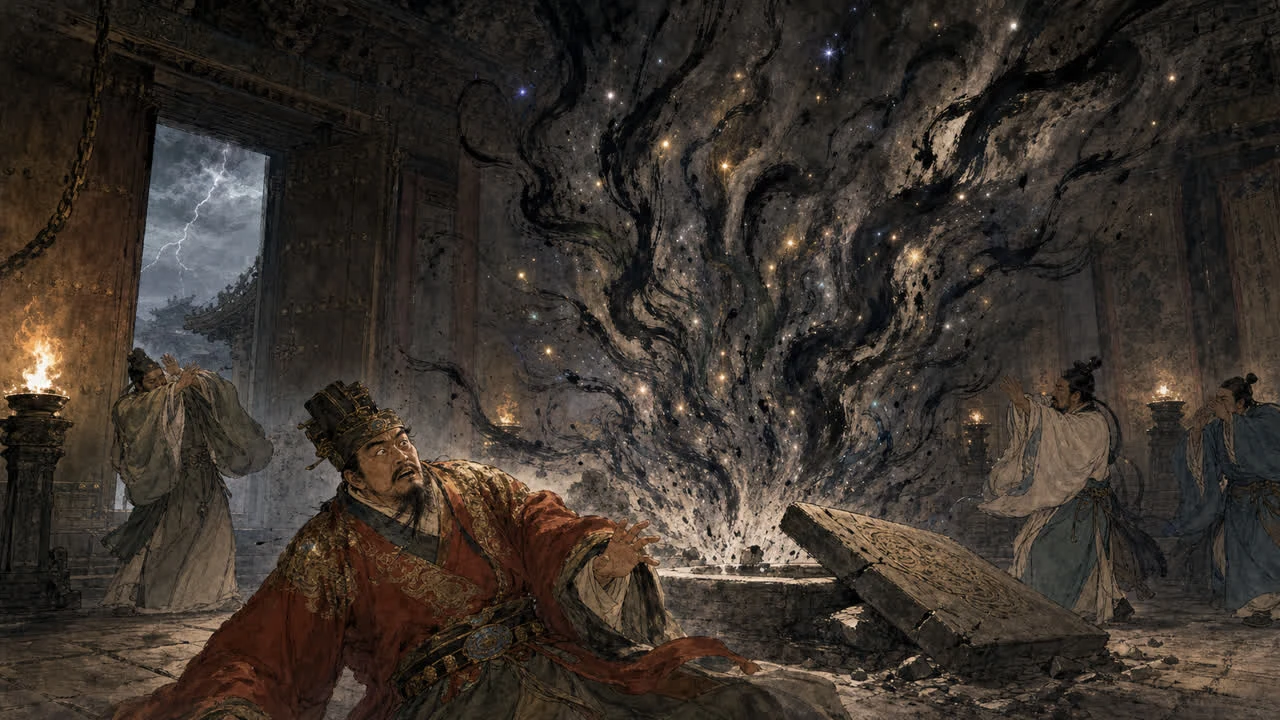
The men heaved the slab up together. Beneath it yawned an abyss of immeasurable depth. And then—a shattering crack!
That sound was no small thing. It was as if heaven collapsed and earth split apart, mountains toppled and peaks crumbled; as when the tidal bore of the Qiantang River bursts through the sea-gate, or the giant god splits Mount Tai with one blow; as when Gonggong in his fury dashed down Buzhou Mountain, or a titan’s hammer smashed the First Emperor’s chariot. A single wind snapped a thousand bamboos—the thunder of midnight among a hundred thousand troops.
When that sound died away, a column of black vapor rolled up out of the pit, tearing off half the corner of the hall roof. The black vapor shot straight into midair and scattered into a hundred streaks of golden light, flying off in every direction.
The men cried out in terror and fled, abandoning hoes and spades, tumbling over one another as they rushed from the hall. Marshal Hong stood gaping, his face ashen, not knowing what to do. He ran out to the corridor, where the abbot came wailing in despair.
“What demon was it that escaped?” asked the Marshal.
The abbot could barely speak—but when he did, the words he spoke would set a whole dynasty on edge. For this was the beginning of a tale in which an emperor would find no rest at night and no appetite by day; in which tigers and leopards would gather in Wanzicheng, and dragons and serpents assemble at Liao’er Slough. What words did the Celestial Master’s abbot speak? Hear them in the next chapter.