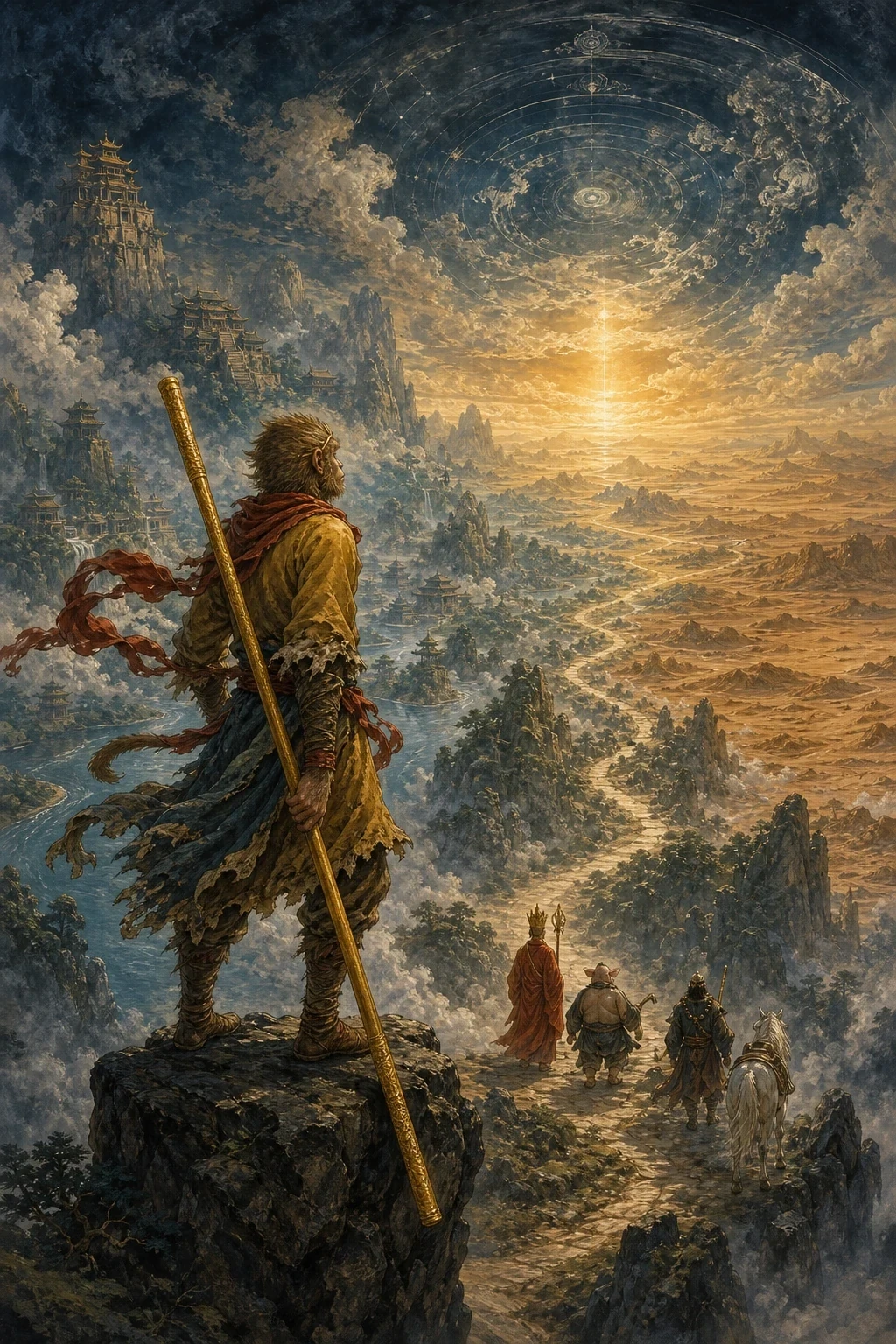
Chapter 1: The spiritual root matures and its source flows forth; the cultivation of heart and nature gives birth to the Great Way.
This is a fresh, complete English translation of Wu Cheng’en’s public-domain one-hundred-chapter novel, produced with GPT-5.3-Codex-Spark assistance. It is an AI-assisted first edition, not a reproduction of an existing translation.
Poem says:
When Chaos was yet undivided, heaven and earth lay in disarray, vast and dim, unseen by any living eye. Since Pangu first rent the primal mists, from that time purity and turbidness have been made distinct. He upheld and bore all beings; by bringing forth all things he made them upright and good. If one would know the primordial art by which Heaven and Earth are ordered, one must read the Tale of Release from Calamity in the Western Journey.
It is said there are one hundred twenty-nine thousand six hundred years in one great cycle (one 元). One cycle is divided into twelve periods, the zodiac branches Zi, Chou, Yin, Mao, Chen, Si, Wu, Wei, Shen, You, Xu, Hai, and then the cycle turns again. Each period is ten thousand eight hundred years. If one examines a day in the same way: in the Zi hour the yang qi is received, and in Chou the rooster crows; in Yin there is no daylight, and in Mao the sun rises; in Chen it is after a meal, and in Si comes the full heat of the day; in Wu the sun is in mid-heaven, and in Wei it moves westward; in Shen comes the afternoon, at You sunset, at Xu twilight falls, and at Hai people come to rest. For this reckoning, when one reaches the end of the Xu phase, heaven and earth grow dim and all things decline. Then, going back five thousand four hundred years to the beginning of the Hai phase, there is darkness, and no creatures remain between heaven and earth; hence it is called confusion. Going on another five thousand four hundred years, as Hai comes to its end and near the arrival of Zi, the primal source rises and things gradually become clear. Shao Kangjie said: “At the winter solstice, in the middle of Zi, heaven’s heart does not change. When the first yang motion appears, all things are not yet born.” From this point heaven begins to have its root. After another five thousand four hundred years, at the true center of Zi, the clean light rises upward. There is the sun, moon, stars, and constellations. Sun, moon, stars, and constellations are called the Four Forms. Therefore it is said, “Heaven opens at Zi.” After yet another five thousand four hundred years, when Zi draws toward Chou, things gradually become firm and stable. The Yijing says: “Great is the Great Origin of Qian, lofty is the Great Origin of Kun. All things are generated by receiving their support, and all follow Heaven.” By this time the earth begins to congeal. After another five thousand four hundred years, in Chou there is heavy turbidity settling: water, fire, mountains, stones, and earth. These are called the Five Forms. Thus it is said that earth opened in Chou. After another five thousand four hundred years, when Chou ends and Yin begins, all things arise. “Heaven qi descends, earth qi rises; heaven and earth join, and all beings are born,” says the calendar. Thus heaven becomes clear, earth becomes bright, and yin and yang combine. After another five thousand four hundred years, at the proper time of Yin, humans are born, beasts are born, and birds are born; this is the positioning of the three powers of heaven, earth, and humanity. Thus it says humans are born in Yin.
Because Pangu opened the universe, then the Three August Sovereigns ruled and the Five Emperors set the order, the world among the heavens was divided into four great continents: Dongsheng Shenzhou, Xiniuhe Zhou, Nanshenbu Zhou, and Beikulu Zhou. This book opens with Dongsheng Shenzhou. Beyond the sea there is a country named Aolai. The country is near the Great Ocean, and in that sea stands a mountain called Flower-Fruit Mountain. This mountain is the ancestral vein of the Ten Continents, the spiritual origin of the Three Isles, born when pure and turbid were separated and formed after the primal chaos was dispelled. Truly a wondrous mountain! A verse testifies to it:
Its influence commands the vast waters; its might calms and secures the Yao Sea. Its influence restrains the great waters: tides surge as silver hills where fish slip into caves. Its power pacifies the Yao Sea, where snow-like waves rise and phantom-beings break from the abyss. In the corners where water and fire gather are piled heights; at the East Sea it rises into lofty crags. Crimson cliffs of strange rocks, with knife-like faces and strange peaks. On the red cliffs two colored phoenixes cry; before the sheer face a lone qilin lies. At the peak-top one can hear a brocade-cock cry, and from the stone caves one often sees dragons come and go. In the woods are long-lived deer and immortal foxes; on trees are mystic birds and black cranes. Jade grasses and rare blossoms do not wither; green pines and lush cypresses are ever-vivid. Immortal peaches bear fruit constantly, and slender bamboo always gathers in clouds. A ravine with dense vines and tendrils, and around four sides the original banks are newly green. Rightly, this is the pillar that holds up all converging rivers, the root of earth unmoving through countless ages.
On its very summit stood a sacred stone, three zhang six chi five cun in height and two zhang four chi in circumference. Three zhang six chi five cun corresponds to the heavens’ three hundred sixty-five degrees; two zhang four chi corresponds to the twenty-four seasonal qi. It has nine apertures and eight cavities, as do the Nine Palaces and the Eight Trigrams. No trees block its shadows on any of its four sides, and to left and right, luxuriant orchids of fragrant orchid-like sheen stand in harmony. Since the time of creation, it had continually absorbed the heavenly purity and earthly brilliance, the essences of sun and moon. Long impressed by these, it awakened to numinous awareness. Within it grew an immortal embryo. One day it split apart and produced a stone egg, round and large as a cue ball. By the wind it was transformed into a stone monkey, complete in five features and all limbs sound. Then it learned to crawl, then to walk, and paid homage to the four quarters. Its eyes sent forth two rays of golden light straight toward the constellation chamber, startling the Great Celestial Compassionate Lord, the Jade Emperor, Supreme Celestial Venerable, the Mysterious Vault High God of the Highest Heaven. Seated on golden-tiered cloud palaces, in the Lingxiao Precious Vault Hall, he assembled immortals and, seeing golden fire-flame, ordered Qianliyan and Shunfeng’er to open the Southern Gate of Heaven and investigate. The two attendants obeyed at once, sharp of sight and keen of hearing. Soon they returned: "As ordered, we have seen. The light comes from the borderlands of a small realm called Aolai east of Dongsheng Shenzhou within this sea. Upon Flower-Fruit Mountain stands a sacred stone from which issued an egg that became a stone monkey in the wind. He worships the four directions there, and his eyes beam gold toward the starry chambers. He now feeds on herbs and stream-water, and the golden light is beginning to subside." The Jade Emperor, with mercy, declared, "The things below are all born of heaven-and-earth essence; there is no cause for wonder."
That monkey in the mountain could walk and leap, ate grasses and wood, drank from stream springs, gathered mountain flowers, and sought fruit; it kept wolves and crawling creatures as companions, had tigers and leopards as a band, roes and deer as friends, and macaques as kin. At night it slept below the stone cliffs, and at dawn it roamed among peak caves. Truly: “In the mountains there is no reckoning of Jiazi years; one does not know when the winter has ended.”
One day, in hot weather, the band of monkeys sought shade from the heat beneath fir trees and played in wildness together. Look at each and every one of them:
Springing to trees and climbing boughs, plucking flowers, seeking fruit. Throwing seed-balls, chasing at the game. Digging sand nests, building miniature pagodas. Pursuing dragonflies, swatting gossamer pests. Wrestling old trunks, bowing to Bodhisattvas. Tearing creepers, braiding wisped grass. Catching lice, biting and pinching. Grooming their fur, scraping their nails. Pushing and pushing, rubbing and rubbing. Shoving and shoving, pressing and pressing. Tearing and tearing, pulling and pulling. Under green pinewood they ran wild; at the edges of verdant streams they laughed and washed.
After a while this troop went to bathe in a mountain brook. They saw the rushing water leaping like rolling melons bursting into spray. It is said of old: ‘Birds have their own speech, beasts their own tongue.’ All cried, ‘Who knows whence this water comes? Today we are free of other duties. Let us play along the stream and follow it upward to seek the source.’ One cry and they came all together, lads and lasses, brothers and siblings, scrambling toward the headwaters, climbing the mountain along the brook until they found a waterfall and spring. There they beheld:
A white arc rose in a single sweep; for a thousand fathoms snow-mixed waves took flight. Sea-wind blows unbroken; the river moon still lights it still. Cool breath splits the blue ridges; lingering current moistens the green haze. That murmuring fall is called a waterfall, as if curtain upon curtain were hung.
The monkeys clapped their hands in praise: ‘Fine water, fine water! It reaches far beneath this mountain foot straight to the waves of the Great Sea.’ Then one said, ‘Let the strongest monkey dive in and find the source, return alive and unhurt; we will make him our king.’ Three times they called, and then from among the crowd leapt a stone monkey in answer, crying, ‘I will go in, I will go in.’ Good monkey, indeed it was he:
Today fame is made manifest, and an age of fortune has come. Fortune and destiny have placed him here; by heaven’s whim he shall enter the halls of immortals.
See how he closed his eyes, crouched low, and with one bound plunged into the cataract spring. He opened his eyes and looked upward; there, beyond, was no water or surge but a clear, lucid span like a bridge. He steadied himself, fixed his mind, and looked again: it was a plate of iron, a bridge of iron plates. Water beneath streamed through holes in rock and ran upside down out beneath, blocking the bridge gates. He stooped and rose to the bridgehead, stepping out again; looking about, he saw a dwelling fit for humans, truly a fine place indeed:
Moss is heaped in blue green; white clouds drift like floating jade. Light shivers among ribbons of rosy cloud. Empty windows, still chambers, smooth benches on which flowers seem to bloom. In milk-white caves, dragon-jewel clusters hang; strange blossoms swirl across the ground. By cliffside hearths faint traces of old fire remain; wine vessels beside tables hold offerings and remains. Stone seats and stone beds are charms to behold; stone bowls and stone trays can be praised the more. Beyond, two, three slender bamboos and a few plums in bloom appear. Several pines forever with dampened leaves make the whole seem like a true dwelling.
After looking for some time, he leapt to the center of the bridge and looked right and left. There, right in the middle, stood a stone tablet with bold regular-script characters carved upon it: "Flower-Fruit Mountain blessed land, Water-Curtain Cave, celestial grotto-heaven."
The stone ape was overjoyed beyond measure. He leapt out, crouched, and rose from the water, saying twice, “Great craftsmanship of Heaven! Great craftsmanship of Heaven!” The monkeys closed around him, asking, “What is inside? How deep is the water?” He answered, “No water at all! It is an iron plate bridge; beyond it lies a home built by Heaven and Earth itself.” They asked, “How can that be a home?” He laughed: “That stream beneath is only the water from above forcing through the stone bridge and hanging down to hide the gate. Beside the bridge are flowers and trees; there is indeed a stone chamber. Within the cave are stone cubicles, stone hearths, stone bowls, stone basins, stone beds, and stone benches. In the center, a stone tablet is engraved: ‘Flower-Fruit Mountain blessed land, Water-Curtain Cave, celestial grotto-heaven.’ Truly it is our place of dwelling. It is broad enough for a hundred households and all kinds of children and elders. We may all enter and live here, safe from Heaven’s harsh breath. Here:
There are places to shelter from wind. In rain one may hold fast and keep one’s shape. Frost and snow cannot alarm. Thunder is never heard. Mists and halos glow always. Auspicious vapors rise in fragrance. Pines and bamboos are ever lush; strange flowers are born anew each day.
Hearing this, the monkeys all rejoiced and one by one said, ‘You go first and lead us in.’ The stone monkey crouched, jumped inside, and called, ‘All follow me in, all in.’ The bold jumped in at once. The timid peered out, drew in their necks, scratched ears and cheeks, and shouted loudly, yet in the end they too entered. Across the bridgehead each scrambled for basins and bowls, fought over hearths and beds, moved and carried things about. Such is monkey-nature—restless, unruly—and only when strength failed and minds grew weary did they stop. The stone ape sat above and said, “Gentles, there is the saying: ‘A man with no trust is fit for nothing.’ You said earlier that whoever could enter and leave here unhurt should be King. I have entered, and gone out; gone out and come in. I have found this cave-heaven where you may rest and sleep in safety, and each may share domestic blessings. Why then do you not honor me as king?” They heard him and with no dissent lowered themselves in homage, lined up by seniority, and knelt upward in reverence, calling him “Thousand-Year Great King.” Thereafter the Stone Ape rose to kingly seat, hiding the word “Stone” in his name and calling himself “Beautiful Monkey King.” A verse records this:
Where sun and moon together gave rise to all life, the immortal stone womb held their essence of sun and moon. Through an egg transformed, he became a perfect monkey, taking name and rank to join the crimson path. Within he perceived formlessness and cause; without he learned to assume manifest shape. Through the ages all men belong to this line, calling him king, calling him sage, roaming unconstrained.
The Beautiful Monkey King led a crowd of macaques, apes, and monkey-kinds, and appointed ministers and assistants among the sovereign officers. By day he roamed Flower-Fruit Mountain; by night they lodged in Water-Curtain Cave. They kept to shared accord and affection, did not join flocks of birds nor bands of beasts, and ruled by themselves alone, rejoicing beyond compare. Therefore:
In spring they gathered hundreds of flowers for food, In summer they sought fruit to make a living, In autumn they harvested yams and chestnuts as the seasons turned, In winter they sought huangjing to pass the passing of the years.
The Beautiful Monkey King enjoyed pure Heaven-born delight for some three or five hundred years. One day, at the height of a feast among monkeys, sudden sorrow overtook him and he wept. His retinue hurried and knelt, crying, “Great King, why this trouble?” He said, “Though I stand in joy, there is one small yet far-reaching worry.” The others laughed: “Great King, how little is your contentment! Each day we feast in joy, in an immortal mountain blessed land and cavernous divine isle; we bow to no qilin command, no phoenix decree, nor are we bound by human royal law. Free and effortless—this is immeasurable blessing. Why should you brood over worries?” The King replied, “Though today we do not submit to mortal kingdoms nor fear the dignity of beasts, in old age blood will thin and grow weak. In secret, Lord Yama oversees the end. If one dies, is it not wasted to have been born to world, unable even for long to dwell within heaven-and-man as the good do?" The monkeys, hearing this, covered their faces and wept, each lamenting impermanence.
Then from the band leaped out a broad-backed ape, voice clear and sharp: “If Your Majesty bears such concern, that is real awakening of the Way indeed. Of all creatures of the fivefold world, only three kinds of name and form are not subject to Lord Yama’s command.” The king asked, “What are these three?” The ape replied, “They are Buddha, Immortal, and Divine-Saint, three kinds who escape the wheel of rebirth and do not perish, sharing longevity with Heaven, Earth, and mountain-rivers.” The king asked, “Where do these three abide?” The ape said, “Only within this Yanfu world, in the immortal mountains of this great sea-continent.” When he heard this, the king’s heart overflowed with joy: “Tomorrow I will take leave of you all and descend the hill to roam the sea’s edges and distant horizons. I will surely seek these three and learn how to live beyond age, forever avoiding Lord Yama’s peril.” With that sentence, the net of rebirth was pierced, leading to the making of the Great Sage Who Equaled Heaven. The monkeys applauded and praised: “Excellent indeed! Excellent indeed! Tomorrow we will climb over the ridge and gather fruits in abundance, prepare a grand feast, and send our lord forth.”
The next day the monkeys truly went to pick immortal peaches, gather strange fruit, dig mountain yam, and dig up huangjing. Aromatic orchids, precious herbs, and wondrous heavenly grasses appeared in complete batches, all laid out in proper rows on stone stools and stone tables, with immortal wine and immortal dishes arranged. As they looked on:
Gold-round, pearl-like fruits and red-split, yellow-plump produce. Golden-orbed wax cherries, truly sweet and beautiful; plums split red and yellow and ripe, whose flavor was fragrant and pleasantly sour. Fresh dragon eyes, sweet flesh with thin skin; Fiery lychee, small seed in red sacs. Apples with blue-green flesh offered in clusters, loquats with pale buds and leaves held upright. Rabbit-headed pears and chicken-hearted jujubes, which quenched thirst, removed vexation, and dispersed drunkenness. Fragrant peaches and ripe apricots, sweet as jade-wine nectar; Crisp plums and yángméi, softly sour like rich creamy paste. Ripe watermelons with red sacs and black seeds, great persimmons with yellow fourfold rinds. Split-open pomegranates, whose cinnabar-like kernels shone like fire-crystal beads; Yam and chestnuts cut open, with hard flesh clumped like golden agate. Walnuts and ginkgo nuts could be steeped into tea; coconuts and grapes could make wine. Hazelnuts, pine nuts, and related nuts filled the trays, while citrus, sugarcane, mandarin orange, and tangerine filled the table. Cooked mountain yam and fully boiled huangjing. Poria and coix seed were pounded and simmered in a stone pot over low fire into gruel. No matter how fine delicacies are in the human world, how could they compare to the monk joy of mountain monkeys.
The troop honored the Beautiful Monkey King above, and all sat by age and rank below. One by one they came forward with wine, flowers, and fruit, and drank in deep measure for an entire day.
The next morning, the Beautiful Monkey King rose early and said: “You little ones, gather some dead pines and weave a raft, take a bamboo pole for a paddle, and pack the fruit I need. I am going.” Alone he stepped onto the raft, pushing it with all his strength, drifting and floating until he reached the mid-sea swells and, catching the sky wind, crossed toward the southern Yanshan Continent boundary. That departure was thus:
Heaven fashioned this immortal ape’s Dao-path in splendor; leaving the mountain he paddled a raft on celestial wind. He sailed the oceans in search of the Way, setting his heart to achieve a mighty work. Born of fate and shared by affinity, he renounced worldly vows. He would surely meet a knowing friend who could explain the source and flow of all Dharma.
This time, as fate had decreed, after he boarded the wooden raft, persistent southeast winds for many days carried him to the northwest shore, which was the boundary of Nanshenbu. He tested the water with his pole, happened upon shallow water, abandoned the raft, and leapt ashore. At the beach there were people catching fish, hunting geese, digging clams, and skimming salt. He came near and put on a show, masquerading as a tiger so they saw, and those people dropped baskets and nets, then scattered in all directions. Seizing one who could not run, he stripped him and put on his clothes. Swaying and staggering, he passed through prefectures and government streets, and in the market towns learned human courtesy and human speech. He ate by day and slept by night, all the while asking after Buddha, Immortal, and Divine-Saint methods, seeking the way of lifelong life and no aging. He saw that men were all for gain and fame, not for preserving life itself. The scene is aptly said in verse:
When will the contest for fame and profit ever end? Late rising and late resting bring no freedom. Riding donkeys yet hoping for fine horses, they seek official rank as ministers and hopes for princes and lords. They only fear weariness from labor over food and clothing, and what if King Yan grabs them with his hook? Sons-in-law and nephews seek wealth and rank; there is scarcely one who would turn back.
The Great Sage once traveled in search of the path of immortality, but by fate had not yet met one. In the Nanzhanbu Continent, he traversed the Great Wall and roamed through small counties, not noticing eight or nine years pass. Suddenly he came to the Great Western Ocean. Thinking that there had to be immortals overseas, he once again made a raft as before and drifted across the western sea until he came to the land of Xiniuhe Continent. After getting off, he searched for a long time, then suddenly saw a beautiful high mountain. Its wooded slopes were deep and secluded. He was not afraid of wild beasts nor of tigers and leopards, so he climbed to the top to look. It was truly a fine mountain:
A thousand peaks stood in ranks like spears, and ten thousand crags opened like unfurling screens. Sunlight reflected on the cloud-ridge, lightly locking green light; rain-cooled indigo held a cool, deep blue. Slender rattan twined around old trees, and the ancient secluded path was hidden. Strange flowers and auspicious grasses, fine bamboo and towering pines. Fine bamboo and towering pines, evergreen for ten thousand ages, outshone blessed lands; Strange flowers and auspicious grasses never faded in any season, like rivals to Penglai. Hidden birds called nearby, and clear springs sang with rushing notes. Valley after valley and gully after gully, orchids and ferns wound through, cliffs everywhere covered with moss. The ridge crests rose and fell in dragon veins; surely a great hermit hid his name there.
He was still watching when he suddenly heard voices from deep in the forest. He hastened forward, slipped among the trees, and listened closely. It was singing. The song was:
"I watch the board of chess grow tattered, axe-clacking in timber-girding strike; at the cloud-edge, in the mouth of the pass, I walk slowly. I sell firewood and buy wine, laughing wildly, drowning my cares in my own intoxication. In the high autumn void I keep the moon in my sight, and by a pine root I rest until dawn. I know the old woods; I climb the cliffs and cross the ridges, axe in hand I cut dead vines. I carry the load back on my back, singing through the market, trading it for three measures of rice. No one argues there, no crowding for quarrel; prices stay plain and fair. I know no crafty schemes, no clever accounting—without honor or shame I drift in gentle ease. Where we happen upon one another, it is either immortals or the Way: sit in stillness and speak on the Huangting."
When the Great Sage heard those words, he was filled with joy and said, "So immortals really are hiding here!" He leapt in at once and looked carefully. It was only a woodcutter, chopping wood there, but even his attire was very unusual:
On his head he wore a rattan hat made from the first sheathing of fresh bamboo shoots. On his body a plain cloth garment, made from tree-cotton spun into silk. Around his waist a rope belt, twined from thread spun from old silkworm mouths. At his feet, grass sandals made from withered rushes. In his hand he held a hard-steel axe, with a hemp rope for hauling. Splitting pines and hewing dead trees, no woodman could match this one.
The Monkey called out as he drew near: "Old immortal, this disciple offers respectful greeting." The woodcutter flustered, dropped his axe, turned, and returned the salute, saying, "Not worthy, not worthy. I am a poor woodman with only enough food and clothing, how can I dare to be called 'immortal'?" The Monkey asked, "If you are not an immortal, how do you speak immortal words?" The woodcutter said, "What immortal words have I spoken?" The Monkey answered, "I only just came to the forest edge and heard you saying: 'Where one meets someone, it is either immortal or Dao; in quiet one sits and talks about the Huangting.' The Huangting is true doctrine of morality and the Dao. Who but an immortal says that?" The woodcutter laughed, "I will not deceive you: this verse is called 'Mantingfang,' taught by an immortal. That immortal lives next door to my hut. Seeing my home full of hardship and worry, he told me that whenever troubles come, I should chant this verse—first to settle my heart, then to untie hardship. I have a few things I cannot figure out, so I recite it; I never expected you to hear it." The Monkey said, "If your home is next to him, why don't you learn from him and gain a method against old age?"
The Monkey said, "From what you say, you are a filial gentleman; in time you will receive good fortune. But if you would show me the abode of that immortal, I would be happy to pay my respects." The woodcutter answered, "Not far, not far. This mountain is called Mount Lingtai Fangcun. In it is the Slanting Moon Three-Star Cave, and in that cave dwells an immortal named Patriarch Subhūti. Disciples of his come and go in numbers beyond counting; even now there are three or four dozen practicing under him. Take that little path, go south for seven or eight li, and there you will find his dwelling." The Monkey seized the woodcutter’s arm. "Brother, come with me. If there is blessing to be had, I will not forget your guidance." The woodcutter replied, "You understand change poorly. I just explained all this to you and yet you did not understand. If I go with you, will I not ruin my trade? Who would care for old mother? I must cut firewood; you go, and go now."
The Monkey took his leave, got onto the path, and after passing over a hillock of about seven or eight li he truly saw a cave residence. He stood and looked; it was truly a splendid place! But he saw:
Mist and colored cloud-scatter, sun and moon swayed with light. A thousand old cypresses, ten thousand upright bamboo culms. The thousand old cypresses, rain-dark and half-airborne, green and drifting; the ten thousand bamboo culms, with smoky haze, one ravine in deep blue. Outside the gate, wondrous flowers spread like brocade; by the bridge, yaocao sent out fragrance. The stone cliffs stood abrupt, smooth with fresh moss; hanging walls rose with long lengths of green lichen. One heard the cries of immortal cranes, and oft one saw a phoenix take to the air. When the crane cried, its voice shook the nine-rough marshes and far heavens; when the phoenix rose, its five colors shone like rainbow light. Black monkeys and white deer appeared and hid at times; gold lions and jade elephants wandered freely. In this sacred blessed land, it truly surpassed heaven itself.
After a while, he heard a sharp cry and the cave gate opened. A celestial boy came out—truly graceful and dignified, with an extraordinary appearance, quite unlike common folk. Yet he looked:
A chignon bound with two silk strands, A wide robe, both sleeves fluttering in the wind. His appearance and form were distinct, his body and mind both empty and clear. A guest beyond worldly dust, a long-lived boy in the mountain. Not a single speck of dust stained him, through one full jiazi-cycle he could still whirl and turn.
After a short time, he suddenly heard a sharp sound and the cave-door opened. A celestial youth came out. He was truly graceful and mighty, his appearance oddly transcendent, wholly unlike ordinary folk. This is how he appeared:
His hair tied in two twisted strands, a wide robe, both sleeves stirring in the wind. His face and form were strange and distinct, his mind and body already clear and empty. A mountain-dwelling guest from beyond the mundane world, the child of eternal life in the hills. Not one dust-particle clings to him; through ten-year cycles he may turn and whirl unharmed.
When the youth came to the gate and called out, "Who is this who disturbs here?" The Monkey leapt from the tree and, bowing, said, "Immortal child, I am a student who has come to seek the Way and study the immortal path. I dare not disturb here." The youth laughed. "You are one who seeks the Way, then?" "Yes," said the Monkey. The youth replied, "My master has only just risen from his couch and mounted the platform to speak on the Way. He had not yet explained the core when he told me to come open the door and said, 'A cultivator has come from outside; go receive him.' I thought it might be you." The Monkey smiled. "It is me. It is me." The youth said, "Come in with me."
The Monkey straightened his clothing and stood respectfully, then followed the youth deep into the cave realm. Layer after layer he beheld deep hall and jade pavilions, inner court after inner court of pearl palaces and shell towers; he could not exhaust the quiet, secluded dwellings. At last, beneath the jade platform, he saw Patriarch Subhūti seated upright. On either side beneath him stood thirty small immortals. He was indeed:
Great-awakened Golden Immortal, stainless in form, Bodhi of the wondrous form of the Western Way. Neither born nor ending, the three-are-as-Three all abide, whole in breath and spirit, all-compassionate in ten thousand hearts. Empty and still, he follows transformation naturally; true-essence as original nature, he lets things be. Body and life share heaven’s own duration, the Great Dharma Master who clarifies mind across aeons.
At first sight, the Great Monkey fell and knelt in full prostration, bowing again and again without count, crying, "Master, Master, this disciple’s heart is set on your instruction; this disciple offers homage with all his heart." The Patriarch said, "From what region are you? Speak your home and name clearly, then bow again." The Monkey said, "My disciple is from the Flower-Fruit Mountain, Hua Guo cave of the Water-curtain in the Aolai Kingdom, on the continent of Dongsheng." The Patriarch snapped: "Get out! You are clearly one who feigns holiness and stirs up emptiness. What kind of fruit of the Way could you seek here?" The Monkey hastened to bow and pleaded, "My disciple speaks plainly; there is no deceit." The Patriarch said, "If you are truly plain, how do you call this place Dongsheng? Between there and here lie two great seas and the Nanzhanbu Continent. How did you come all this way?" The Monkey prostrated: "My disciple crossed the sea, visited the worlds by crossing borders, and after ten or so years only now found this place."
The Patriarch said, "Since you have come gradually, that is enough. What is your surname?" The Monkey answered, "I have no surname. If people scold me, I am not angry; if they strike me, I do not resent. I only make the courtesy of greeting; I have had no surname for life." The Patriarch said, "That is not this 'nature'. What were your parents' surnames?" The Monkey said, "I have no father or mother." The Patriarch said, "If you have no parents, perhaps you were born from a tree?" The Monkey said, "Though I was not born from a tree, I was born from stone. I only remember that on Flower-Fruit Mountain there was one sacred stone; in the year it split open, I came into being." Hearing this, the Patriarch was pleased inwardly: "This indeed is a heaven-born one. Stand up and I will look at you walk about." The Monkey leapt up, turning and circling twice. The Patriarch smiled, "Though your body is crude, you look like a monkey that cracks pine nuts. I will give you a surname, and the idea is to call it 'Hu'. Take away the beast radical from 'hu'; it becomes 古 and 月. 古 means old; 月 means yin. Old yin cannot nurture and generate, so 'Sun' is better. Take away the beast radical from 'Sun'; it becomes 子 and 系. 子 means a son, and 系 means the helpless tender child, fitting the nature of infancy. Let your surname be 'Sun'." The Monkey, pleased, knelt and said, "Good! good! good! Today I at last know my surname. I beg the Master for mercy: now that I have a surname, please grant my name so I may be called." The Patriarch said, "In my sect there are twelve characters used for naming; you are the tenth generation of junior disciple." The Monkey asked, "What are the twelve?" The Patriarch answered, "They are Guang, Da, Zhi, Hui, Zhen, Ru, Xing, Hai, Ying, Wu, Yuan, and Jue. For you comes the character 'Wu'. Your Dharma name shall be 'Sun Wukong'. Is it good?" The Monkey laughed, "Good! Good! good! From now on I shall be called Sun Wukong." It was said:
Before vast chaos was opened, there was no surname at all; to split the stubborn void, one must become Wukong.
In the end, what sort of Way and fruition he would go on to cultivate was still unknown. Hear on in the next installment.