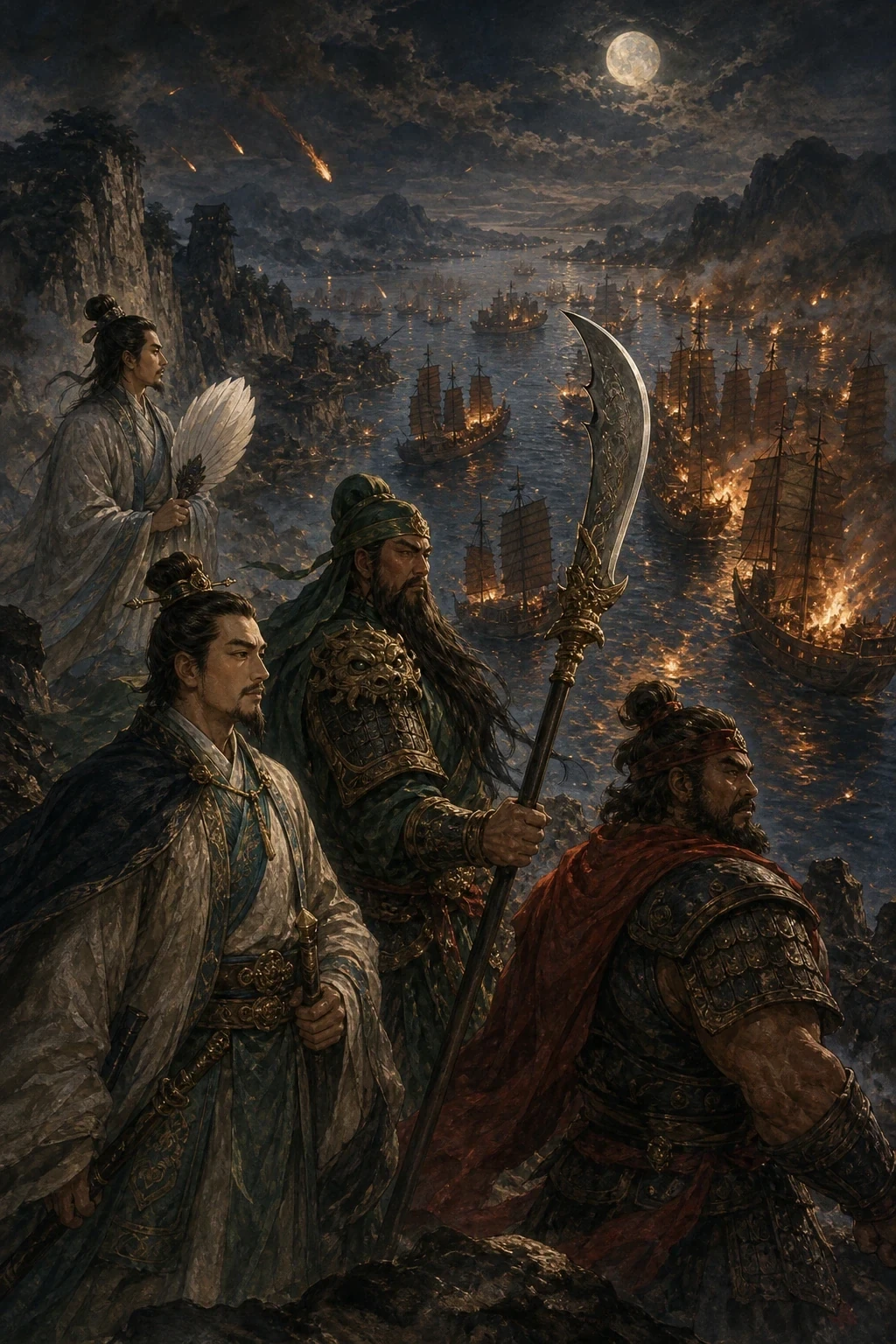
The Oath of the Three Heroes in the Peach Garden: The First Deed of Merit Against the Yellow Turbans
Opening poem
The Yangtze rolls east in endless flood; its churning waves scour away heroes as time goes by. Victories and defeats turn empty in an instant: green mountains remain, and the setting sun burns red again and again. White-haired fishermen and woodcutters on the river islets, have long watched autumn moonlight and spring wind. A jar of cloudy wine meets us in glad reunion: of all things past and present, all are laid into easy talk.
Now the great affairs of the realm follow a general course: after long division comes unity, and after long unity comes division. At the end of Zhou, seven states contended until Qin united them. After Qin fell, Chu and Han contended until Han united them. The Han dynasty began when Emperor Gaozu raised his cause after slaying the white serpent and brought all under Heaven under one rule. Later Emperor Guangwu restored the dynasty, which passed down to Emperor Xian and then divided into three kingdoms. Tracing the origins of the disorder, they began chiefly under Emperors Huan and Ling. Emperor Huan proscribed worthy men and placed his trust in eunuchs. When he died and Emperor Ling ascended, General-in-Chief Dou Wu and Grand Tutor Chen Fan assisted the throne. The eunuch Cao Jie and others were then manipulating power. Dou Wu and Chen Fan plotted to execute them, but the plan was not kept secret, and they themselves were killed. From then on, the palace eunuchs grew still more overbearing.
In the second year of Jianning, on the full-moon day of the fourth month, the emperor entered Wende Hall. Just as he took his seat, a sudden gale tore through a corner of the hall; a great green serpent flew down from a roof beam and coiled upon the throne. The emperor fainted in terror. His attendants hurried him into the inner palace, and all the officials fled. Soon the serpent vanished. Then came violent thunder, rain, and hail, which did not cease until midnight and destroyed countless houses.
In the fourth year of Jianning, second month, Luoyang suffered an earthquake. Again the sea overflowed, and along the coast residents were swept away by the flood waves. In the first year of Guanghe, hens turned into roosters. On the first day of the sixth month, more than ten zhang of black vapors flew into Wende Hall. In autumn’s seventh month, a rainbow appeared in Yutang Hall; the banks of Wuyuan Mountain split apart. These signs were many and grave.
The emperor issued an edict asking ministers about the omens. Court advisor Cai Yong submitted a memorial, arguing plainly that the fallen rainbow and hens changed into roosters came from the inner-court women and eunuchs meddling in government. The emperor read it, sighed, and rose to change his robes. Cao Jie looked from behind, reported what he had heard to everyone nearby, and by another pretext charged Cai Yong with a crime and sent him home. Soon afterward Zhang Rang, Zhao Zhong, Feng Xu, Duan Gui, Cao Jie, Hou Lan, Jian Shuo, Cheng Kuang, Xia Yun, and Guo Sheng—ten in all—banded together as the “Ten Eunuchs.” The emperor trusted Zhang Rang deeply and called him “Ah Father.” Court government went wrong day by day; popular minds turned toward disorder and brigands and bandits rose.
At that time, in Julu Commandery, there were three brothers: one named Zhang Jiao, one Zhang Bao, and one Zhang Liang. Zhang Jiao was a scholar who had failed the examinations. Entering the mountains to gather medicinal herbs, he met an old man with blue eyes and a youthful face, holding a staff of goosefoot. The old man called him into a cave and gave him three volumes of a heavenly book. “This is called the Essential Arts of Great Peace. Once you receive it, you must proclaim the Way on Heaven’s behalf and bring salvation to all people. If any disloyal thought arises in you, you will surely meet with retribution.” Jiao bowed and asked his name. The old man answered, “I am the Old Immortal of Nanhua.” Having spoken, he changed into a clear breeze and vanished.
Once Jiao had obtained the book, he studied and practiced day and night. He learned to summon wind and rain and took the title “Daoist of Great Peace.” In the first month of the first year of Zhongping, an epidemic spread. Zhang Jiao distributed talisman water and treated the sick, calling himself “the Great Worthy and Good Teacher.” He had more than five hundred disciples who traveled in every direction, all able to write talismans and recite incantations.
As his followers multiplied, Jiao organized thirty-six divisions. A large division had more than ten thousand members; a small one, six or seven thousand. Each had a leader whom they called a general. He spread the saying: “The Blue Heaven is dead; the Yellow Heaven shall rise. In the year jiazi, great fortune will come to the realm.” He ordered every household to write the two characters jiazi (甲子) on its main gate with white clay. Throughout the eight provinces of Qing, You, Xu, Ji, Jing, Yang, Yan, and Yu, household after household revered the name of Zhang Jiao, the Great Worthy and Good Teacher.
Jiao sent his follower Ma Yuanyi secretly bearing gold and silk to win over the eunuch Feng Xu as an agent within the palace. Jiao and his two brothers discussed: “Nothing is harder to obtain than the people’s hearts. Now their hearts already turn to us. If we do not seize the moment and take the realm, it will be truly regrettable.” He secretly made yellow banners and fixed a date for the uprising.
At the same time he sent his disciple Tang Zhou with a dispatch to Feng Xu. Tang Zhou instead rushed to the capital and reported the plot. The emperor ordered General-in-Chief He Jin to arrest Ma Yuanyi and execute him; then Feng Xu and the rest were also arrested and imprisoned.
When Zhang Jiao heard the affair was exposed, he raised troops overnight and proclaimed himself “General of Heaven”; Zhang Bao proclaimed himself “General of Earth”; Zhang Liang proclaimed himself “General of Men.” He told the band: “The Han order is ending, and the Great Sage has appeared. All of you should follow Heaven’s will and move uprightly, to delight in peace.” Four or five hundred thousand commoners in the realm bound yellow cloth on their heads and rose with him. The rebels’ force was vast, and the official troops, by the wind of fear, scattered.
He Jin petitioned the emperor to issue urgent commands ordering every district to prepare its defenses and win merit by suppressing the rebels. At the same time, Colonels Lu Zhi, Huangfu Song, and Zhu Jun were each sent with elite troops along separate routes to attack them.
Now Zhang Jiao’s army advanced into the territory of You Province. Its administrator, Liu Yan, was a native of Jingling in Jiangxia and a descendant of Prince Gong of Lu of the Han house. When he heard that the rebel army was approaching, he summoned Colonel Zou Jing for counsel. Zou Jing advised, “Their troops are many and ours few. My lord, you should recruit men at once to meet them.” Liu Yan agreed and immediately posted notices calling for volunteers.
The notices reached Zhuo County and drew out a hero from there. He cared little for reading; his nature was generous and mild, and he spoke little. Neither joy nor anger showed on his face. He had long harbored great ambitions and delighted in befriending the realm’s heroes. He stood seven chi and five cun tall; his ears hung to his shoulders, his hands reached below his knees, and when he looked straight ahead he could glimpse his own ears. His face was like fine jade and his lips as though painted with rouge. He was Liu Bei, whose courtesy name was Xuande, a descendant of Liu Sheng, Prince Jing of Zhongshan, and a remote descendant of Emperor Jing of Han. Liu Sheng’s son Liu Zhen had been enfeoffed as Marquis of Zhuolu Village under Emperor Wu, but lost his marquisate for failing to contribute the proper ceremonial gold. This branch of the family therefore remained in Zhuo County.
Liu Bei’s grandfather was Liu Xiong, his father Liu Hong. Liu Hong once passed as filial and served as an official, but died young. Liu Bei was orphaned early and filial to his mother. Poor, he sold sandals and mats for his livelihood. His house stood in Lou-sang village of the county. To the southeast, a tall mulberry tree rose more than five zhang, looking from afar like a wagon canopy. Fortune-tellers said, “A noble man will come from this house.” As a boy, Liu Bei played with village children beneath it and said, “I will one day be Son of Heaven and ride this canopy.” His uncle Liu Yuanqi saw and said, “This child is not ordinary,” and because the family was poor, he often supplied him. At fifteen, his mother sent him to study. He once studied under Zheng Xuan and Lu Zhi and was friend to men like Gongsun Zan. When Liu Yan called for volunteers, Liu Bei was already twenty-eight.
On seeing the announcement, he sighed deeply. Immediately a man raised his voice: “A real man does not waste effort on the state and then sigh so long. Why this?”
Liu Bei looked at him. The man was eight chi tall, with a tiger-bearded face and bold eyes like a leopard, chin like a swallow’s head, voice like thunder, and a gait like a war horse. Liu Bei asked his name.
“The surname is Zhang, name Fei, courtesy name Yide. We live in Zhuo Commandery, hold some broad fields, and make a living selling wine and meat. I enjoy befriending heroes across the land. I only saw you reading and sighing and thus asked.”
Liu Bei said, “I am of the Han imperial kin, surname Liu, name Bei, courtesy name Xuande. Hearing that the Yellow Turbans have risen, I desire to break them and bring the people peace, but my strength is small, so I sigh.”
“Good,” said Fei. “I have some resources. Let me recruit village fighters and join you.” Liu Bei was very glad. They entered an inn and drank together.
While they drank, a big man came pushing a cart and halted at the tavern gate. Sitting down, he called the server: “Quickly pour wine. I must hurry into the city to enlist.” Liu Bei saw him. He was nine chi tall, with a beard nearly two feet long, a face like a ripe jujube, and lips like painted rouge. His eyes were like dark phoenixes, brows like curled silk. He looked grand and imposing. Liu Bei invited him to sit and asked his name.
“My surname is Guan, my given name Yu, and my courtesy name was Changsheng, later changed to Yunchang. I come from Xieliang in Hedong. A local bully relied on his power to mistreat others, so I killed him and fled abroad for five or six years. Hearing of this call to arms, I came to volunteer.”
Liu Bei explained his purpose. Guan Yunchang rejoiced greatly. The three men went to Zhang Fei’s village homestead and discussed the matter.
“Behind my farm is a peach garden in full blossom,” Zhang Fei said. “Tomorrow we will hold sacrifice to Heaven and Earth there. The three of us shall become brothers and unite in intent and strength before we attempt anything great.” Liu Bei and Guan Yu answered, “That is excellent.”
The next day in the Peach Garden they prepared rituals with white ox, white horse, and incense. The three burned incense and knelt twice, swearing:
“Take Liu Bei, Guan Yu, and Zhang Fei: though our surnames are not one, once we have sworn brotherhood we shall join heart and mind, rescue those in distress and help those in danger, serve the state above and bring peace below. We do not ask to be born same year, month, or day; we only ask to die in one same year, month, and day. Heaven and Earth know this heart. Those who betray loyalty and forget gratitude, let Heaven and men together slay them.”
After the oath, Liu Bei was declared elder brother, then Guan Yu, then Zhang Fei. After worshiping Heaven and Earth, they slaughtered an ox, set out wine, gathered villagers with courage, and more than three hundred arrived. The three drank till the Peach Garden rang with cheers. The next day they arranged their arms and armor and regretted they had no horses.
While they were thinking this over, news came that two guests had arrived leading a troop and horses at full pace. Liu Bei said, “Heaven is helping us.” The three men met them at the gate. The two were great merchants from Zhongshan: Zhang Shiping and Su Shuang, who annually sold horses northward and had returned because of raids.
Liu Bei treated them well, shared wine, and told them of his wish to defeat rebels and comfort the people. The two were glad and offered fifty fine horses, five hundred taels in gold and silver, and one thousand jin of iron for supplies.
Liu Bei thanked them and had local smiths forge a pair of swords. Guan Yu had a Green Dragon Crescent Blade made, also called the “Cold-Beauty Saw,” weighing eighty-two jin. Zhang Fei had a one-zhang-eight-chi pointed steel spear made. All three donned full armor. Gathering more than five hundred village fighters, they came to see Zou Jing, who presented them to Administrator Liu Yan.
The three introduced themselves. Liu Yan rejoiced and welcomed Liu Bei as nephew.
Not long after, reports came that Cheng Yuanzhi, a rebel commander under Zhang Jiao, was leading fifty thousand men to attack Zhuo Commandery. Liu Yan ordered Zou Jing to take Liu Bei and the two in charge of five hundred troops. He had them go first to fight. Liu Bei took command with joy and advanced to the foothills of Daxing Mountain, where the rebels stood.
The rebels had unbound hair and yellow cloth bound around their brows. The two armies faced each other. Liu Bei mounted, with Guan Yu on his left and Zhang Fei on his right, raised his whip, and shouted, “You traitors who have rebelled against the state, why do you not surrender now?”
Cheng Yuanzhi raged and sent his deputy Deng Mao to battle. Zhang Fei thrust his long snake spear forward, and with one motion he drove it into Deng Mao’s heart. The rebel tumbled from the saddle. Seeing Deng Mao dead, Cheng Yuanzhi whipped his horse and drew his blade to charge Zhang Fei. Guan Yu mounted and swung his great sword. Shocked, Cheng Yuanzhi could not respond and was cut in two.
A later poem praised them:
A hero shows his edge in this hour: first test of spear, first test of sword. From the first clash his might is revealed, and in three notes his name is set to remember.
Seeing their commander cut down, the rebels all threw aside their weapons and ran. Liu Bei sounded the charge and gave chase. Captured men were countless; they returned in a great victory. Liu Yan met them in person and rewarded the troops.
The next day came a memorial from Gong Jing, Administrator of Qing Province, saying the city was besieged and about to fall, imploring help. Liu Yan discussed it with Liu Bei.
“I am willing to go,” said Liu Bei.
Liu Yan ordered Zou Jing to take five thousand troops and send Liu Bei, Guan Yu, and Zhang Fei to Qing Province. The rebels saw the rescue force and split and fought hard. Liu Bei’s force was too small and withdrew thirty li to camp.
“There are too many rebels and not enough of us. We need a surprise force to win,” Liu Bei told Guan Yu and Zhang Fei. He posted Guan Yu with one thousand troops on the mountain left, Zhang Fei with one thousand on the right, and used gongs and struck metal as the signal for all to come out and support.
The next day Liu Bei and Zou Jing marched forward with drums and horns. The rebels met and fought. Liu Bei then withdrew his lines. When the rebels pursued past the ridge, all Liu Bei’s army rang metal at once, and both flanking detachments emerged together. Liu Bei turned his whole host and struck back.
Encircled on three sides, the rebels collapsed and fled. They were chased to the foot of Qing Province’s wall, where Administrator Gong Jing also led citizen troops out to help. The rebel force suffered terribly; the siege of Qing Province was lifted.
Later, people composed a poem praising Liu Bei:
His planning and calculations had divine merit; one dragon could still make two tigers yield. From his first charge he already left great achievements; in due course he should share in the partition of the realm.
After feeding the troops, Gong Jing had them rewarded. Zou Jing wished to return. Liu Bei said, “I have heard that General-in-Chief Lu Zhi and rebel head Zhang Jiao are contesting in Guangzong. I once studied under Lu Zhi and want to go to his aid.” Zou Jing then withdrew with the main force. Liu Bei, Guan Yu, and Zhang Fei set out with their own five hundred to Guangzong.
When they entered Lu Zhi’s camp, they came to his tent, made proper bows, and stated their intent. Lu Zhi was very pleased and kept them there while making plans.
At that time Zhang Jiao’s force was one hundred and fifty thousand; Lu Zhi had only fifty thousand. They stood at Guangzong with no winner yet. Lu Zhi told Liu Bei: “I am besieging them here; Zhang Liang and Zhang Bao are in Yingchuan, opposing Huangfu Song and Zhu Jun. You bring your own men; I will add one thousand soldiers of the court and send you to Yingchuan to gather intelligence and set a date to destroy them.”
Liu Bei took the order and rode through the night to Yingchuan. There Huangfu Song and Zhu Jun were already repelling rebels. The rebels were not winning in open battle and had fallen back into Changshe to build camp in grass. Song and Jun concluded, “They are camping among grass; we should attack by fire.” So they had each soldier carry a bundled sheaf of grass in secret. After the second watch, with wind suddenly rising, all the troops set fire together. Song and Jun then attacked the camp in turn.
Fire rose into the sky. The rebels panicked—no one could saddle horses, no one buckle armor—so they scattered. By dawn, Zhang Liang and Zhang Bao, leading remnants, fled. Suddenly they saw a body of horsemen ahead, all displaying red banners, closing the road. At their fore a general appeared: seven chi tall, narrow eyes and a long beard. He was a Cavalry Commandant from Qiao County in the state of Pei: Cao Cao, whose courtesy name was Mengde.
Cao Cao’s father, Cao Song, was originally surnamed Xiahou; because he had been adopted by Grand Eunuch Cao Teng, he took Cao as his surname. Cao Cao’s childhood name was A-Man, and he was also called Jili. As a boy he loved hunting, roaming, singing, and dancing; he was resourceful and quick-witted. An uncle often grew angry at his wandering ways and reported them to Cao Song, who would reprimand him. Cao Cao then devised a plan: when he saw his uncle approaching, he fell to the ground and feigned a seizure. The uncle, alarmed, reported this to Cao Song. Cao Song hurried to see his son and found him perfectly well. “Your uncle says you suffered a seizure,” he said. “Are you recovered?”
“I have never had such an illness,” Cao Cao replied. “My uncle no longer cares for me, so he deceived you.”
Cao Song believed him, and after that, even when the uncle kept blaming Cao, Cao Song no longer listened. So Cao Cao was allowed to enjoy himself as he wished.
At that time Qiao Xuan said to him, “The world is about to fall into disorder. Only one endowed with the talents to command an age can save it. Could that man be you?” He Yong of Nanyang saw Cao Cao and said, “The Han house is about to fall. The man who can bring peace to the realm must be this one.” Xu Shao of Runan, famed for his ability to judge character, also met Cao Cao. Cao Cao asked, “What kind of man am I?” Xu Shao did not answer. Asked again, he said, “In times of peace, you would be a capable minister; in times of disorder, a treacherous hero.” Cao Cao was delighted.
At age twenty, Cao passed the filial official test and became a court gentleman; he was appointed Northern Capital Captain of Luoyang. Soon after, he placed more than ten-colored rods at the four gates of the commandery. If any transgressed, whether rich or poor, he could punish them with the rods. One night eunuch Jian Shuo’s uncle walked with drawn sword; Cao caught him on patrol and punished him with rods. Thus no one dared to offend inside or out, and his fame was powerful.
Later he became Magistrate of Dunqiu. Because of the Yellow Turban uprising, he was appointed Cavalry Commandant and brought five thousand cavalry and infantry to Yingchuan to assist. Just as Zhang Liang and Zhang Bao had been defeated and were fleeing, Cao Cao intercepted them, beheaded over ten thousand men, and took many banners, drums, and horses. Zhang Liang and Zhang Bao fought hard and slipped away.
Cao then met Huangfu Song and Zhu Jun and immediately pursued them.
Returning now to Liu Bei and his men: they rode into Yingchuan hearing cries and seeing fire light the sky. They arrived to find the rebels already dispersed. Liu Bei reported to Huangfu Song and Zhu Jun that Lu Zhi had asked, and Song said, “Zhang Liang and Zhang Bao are near ruin and exhaustion; they must flee to Guangzong and connect with Zhang Jiao. Liu Bei, go at once by night and aid.”
Liu Bei took command and marched. Halfway, he saw horsemen guarding a barbed cage-cart; inside was Lu Zhi. Liu Bei dismounted and asked what had happened.
Lu Zhi answered, “I surrounded Zhang Jiao and nearly won. Yet because he used sorcery, I could not take him immediately. The court sent Palace Attendant Zuo Feng to inspect and demand bribes. I replied, ‘Army rations are still lacking. Where can I find extra silver to flatter messengers from Heaven?’ He resented it and reported that I sat idle on the high wall and was lazy and harming the troops’ spirit. The court grew furious and sent General Zhonglang Dong Zhuo to replace me and bring me back for charges.”
Zhang Fei, hearing this, grew furious and wanted to execute the escort immediately to free Lu Zhi. Liu Bei restrained him: “The court has official process. How could you act rashly?” The escortmen carried Lu Zhi onward.
Guan Yu said, “Middle Gentleman Lu has been seized. If another takes command now, we will have nowhere to rely. Better return to Zhuo Commandery.” Liu Bei agreed. They moved north.
Before two days passed, they heard a great shout from behind from the hills. Liu Bei rode with Guan Yu and Zhang Fei to a high knoll and looked out. Han troops had been badly beaten; behind them rebel forces covered hills and fields, their flags marked “General of Heaven.”
“This is Zhang Jiao,” Liu Bei said. “We must attack at once.” The three spurred forward with their force. Zhang Jiao had just defeated Dong Zhuo and was pressing the pursuit when the three charged into him. His army fell into confusion and fled more than fifty li.
The three rescued Dong Zhuo and brought him back to camp. He asked their rank. Liu Bei answered, “Common soldiers.” Dong Zhuo made no courtesy and offered little respect. Liu Bei stepped away. Zhang Fei was enraged and said, “We rode straight into bloodshed and saved this man, and he answers without honor! If we do not kill him, my anger cannot settle.” He reached for his blade and entered his tent to kill Dong Zhuo.
The narrator says:
The world’s gains and losses and men’s motives are the same now as in old times. Who can tell at once which is truly a hero and which is but a common man? If only there were a quick-handed man like Yide, all traitors in the world should be erased at once.
How this turned out will be told in the next chapter.